

Programs Overview
Past Events
ROCK Weekend
Upcoming Events
Blog
Resource Hub
Sponsor
Volunteer
Partner with Us
Ways to Support
Share Your Story
Join Our Network
Our Impact
Why BIPOC?
Our Approach
Who We Are
Common Questions
Community Care Collaborative
ROCK it Wellness
The AIP BIPOC Community
The AIP BIPOC Roundtable
Powering Advocacy

Prevention is often talked about, but rarely built into the communities that need it most.
For The AIP BIPOC Network (ABN), this work is not new. It is central to how we approach health equity, chronic illness, and long-term wellness through our programs, advocacy, and community engagement.
This includes cancer prevention, which is shaped by the same underlying drivers as autoimmune disease and other chronic conditions.
That is why ABN has joined the Be Well Acres Homes Steering Committee, an initiative led by MD Anderson Cancer Center.
The Steering Committee coordinates prevention efforts across organizations working in the community. Serving on the committee allows ABN to apply its Dual Framework in real time, connecting broader strategies with the lived experiences of those navigating chronic illness.
Key Takeaways
- ABN is serving on the Be Well Acres Homes Steering Committee
- Cancer prevention is directly connected to chronic illness and autoimmune health
- The ABN Dual Framework connects system-level change with individual health behaviors
- Community-led models support more sustainable, long-term impact
Why Cancer Prevention Matters to ABN
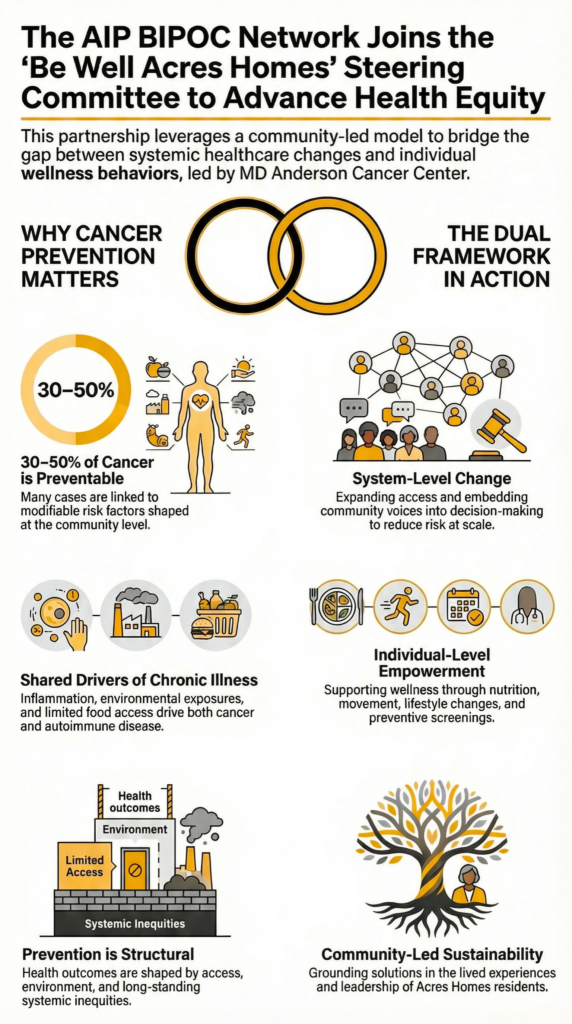
Cancer is not separate from autoimmune disease or chronic illness. It exists within the same system of factors that shape long-term health outcomes. The same conditions that drive inflammation, limit access to care, and influence daily health behaviors also increase cancer risk.
These conditions are shaped by many of the same underlying drivers:
- chronic inflammation
- environmental exposures
- limited access to nutrient-dense food
- stress and social determinants of health
- gaps in preventive care
Up to 30–50% of cancer cases are preventable by addressing modifiable risk factors, many of which are shaped at the community level (source: www.who.int/news-room/fact-sheets/detail/cancer).
That means prevention is not just clinical, it is structural.
And that is where ABN operates, at the intersection of systems, access, and everyday health.
The ABN Dual Framework in Action
This work reflects ABN’s Dual Framework in practice and aligns with how Be Well Communities approaches prevention.
Be Well Communities is built around the idea that prevention is most effective when it is designed within the community, not delivered to it. That requires coordination across systems, while staying grounded in the realities people navigate every day.
ABN’s Dual Framework connects those two sides of the work.
System-Level Change
Access. Inclusion. Prevention.
Through the Steering Committee, this connects to:
- expanding access to preventive services
- embedding community voice into decision-making
- addressing environmental and structural drivers of health
This is how risk is reduced at scale.
Individual-Level Empowerment
Nutrition. Movement. Lifestyle.
At the same time, prevention is reinforced through:
- healthy eating
- active living
- preventive screenings
- reducing harmful exposures
These are the same principles that guide ABN’s approach to autoimmune and chronic illness support.
Different entry point. Same goal, reducing risk and improving long-term health outcomes.
Why Acres Homes
Acres Homes is a historically underserved community with deep roots and a strong tradition of local leadership.
Like many communities, it continues to face structural challenges that shape health outcomes, including limited access to preventive care, higher exposure to chronic disease risk factors, and gaps in infrastructure that support long-term wellness.
These challenges are not isolated. They are shaped by access, environment, and long-standing inequities that influence how health shows up at the community level.
Be Well Acres Homes focuses on addressing these realities through a community-driven approach, working alongside residents and local leadership to build solutions that are relevant, sustainable, and grounded in lived experience.
At the same time, access to care is not only about systems. It is also about knowing what exists within the community.
Local organizations are already doing the work to connect residents with resources, education, and opportunities to stay engaged in their health.
The Acres Homes Community Advocacy Group (CAG) plays a key role in this effort, supporting community engagement and helping residents stay informed and involved in local health initiatives.
Explore available resources and learn more:
www.acreshomescag.org/
What This Work Represents
This work reflects a broader shift in how prevention is approached.
Not as a single program or intervention, but as a coordinated effort shaped by community, systems, and the conditions that influence health every day.
From cancer prevention to chronic illness, the same underlying drivers continue to show up. Addressing them requires alignment across sectors, sustained investment, and approaches that are grounded in real-life experience.
That is where this work sits.
For ABN, serving on the Be Well Acres Homes Steering Committee is one way to stay connected to how prevention is being shaped at the community level, alongside others working toward the same goal.
As this work evolves, so will the opportunities to engage, learn, and strengthen how prevention is delivered and experienced.
Common Questions
What is the Be Well Acres Homes initiative?
Be Well Acres Homes is a community-based health initiative led by MD Anderson Cancer Center that focuses on cancer prevention through local partnerships, education, and access to resources.
What does the Steering Committee do?
The Steering Committee helps guide strategy, priorities, and implementation of community health efforts. Members provide input to ensure initiatives reflect the needs of the community.
Why is cancer prevention important in community health?
Many cancer cases are linked to factors like nutrition, environment, and access to care. Community-based prevention helps address these factors before disease develops.
How does this connect to chronic illness and autoimmune disease?
Cancer, autoimmune disease, and other chronic conditions share common risk factors such as inflammation, environmental exposure, and limited access to preventive care.
What role does ABN play on the Steering Committee?
ABN contributes lived experience, community perspective, and insight into chronic illness to support more relevant and inclusive prevention strategies.
What is ABN’s Dual Framework?
ABN’s Dual Framework focuses on system-level change, access, inclusion, prevention, and individual-level health, including nutrition, movement, and lifestyle.

Leave a Reply


Programs Overview
Past Events
ROCK Weekend
Upcoming Events
Blog
Resource Hub
Sponsor
Volunteer
Partner with Us
Ways to Support
Share Your Story
Join Our Network
Our Impact
Why BIPOC?
Our Approach
Who We Are
Common Questions
Community Care Collaborative
ROCK it Wellness
The AIP BIPOC Community
The AIP BIPOC Roundtable
Powering Advocacy
© 2026 The AIP BIPOC Network, INc | EIN # 92-2526059 | all rights reserved | legal