




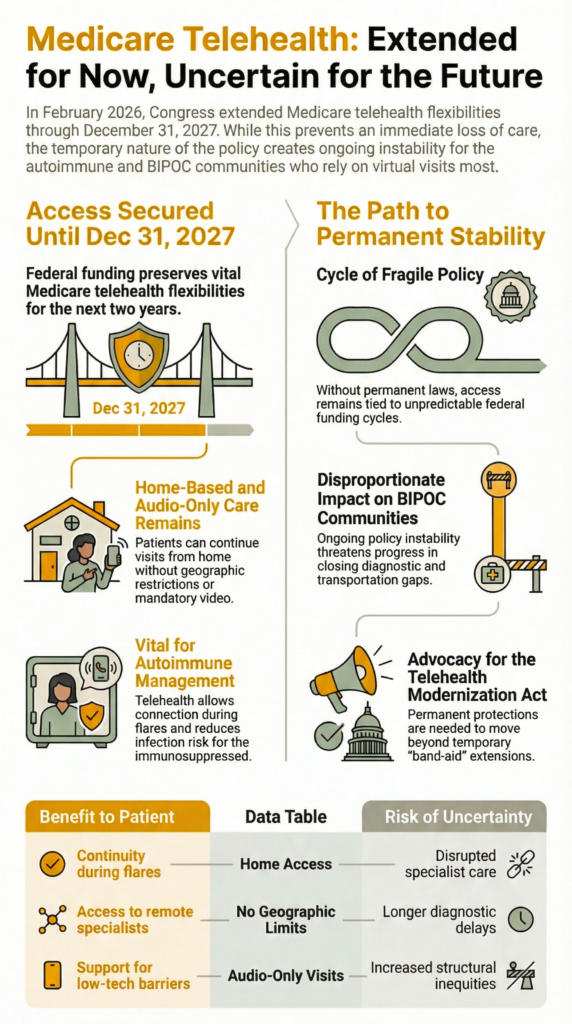
In February 2026, Congress passed a federal funding package that temporarily extends Medicare telehealth flexibilities through December 31, 2027.
This prevents an immediate loss of access.
But it does not solve the problem.
If you followed what happened when telehealth protections expired in 2025, you already know how quickly access can shift. If not, read our full breakdown here: National Coalition Urges Congress to Restore Medicare Telehealth Access
That moment exposed how fragile telehealth policy still is. This extension confirms it.
Key Takeaways
- Medicare telehealth has been extended through December 31, 2027
Patients can continue accessing many services from home - This is a temporary fix, not a permanent solution
Policy remains tied to federal funding and ongoing negotiations - Core access protections remain in place for now
Including home-based care, fewer geographic restrictions, and audio-only visits - Uncertainty still affects providers and patients
Long-term rules and reimbursement structures are not fully resolved - Autoimmune and BIPOC communities remain heavily impacted
Ongoing instability continues to affect access, continuity, and outcomes - Advocacy efforts are still critical
Coalition work, including ABN’s, continues to push for permanent protections
What the Extension Actually Does
The 2026 extension preserves several key telehealth flexibilities:
- Access to telehealth visits from home
- Removal of geographic restrictions for many services
- Continued coverage for audio-only visits
- Expanded provider eligibility
For many patients, this maintains continuity of care.
But it does not guarantee stability beyond the current deadline.
What Has Not Been Resolved
The extension does not address the underlying issues:
- Telehealth policy is still temporary
- Long-term legislation, including the Telehealth Modernization Act, remains unresolved
- Providers continue to navigate inconsistent guidance
- Patients are left uncertain about future access
This creates a cycle where access is repeatedly at risk, restored, and left unresolved.
Why This Still Matters for Autoimmune Patients
Telehealth remains a critical part of managing autoimmune disease.
It allows patients to:
- Stay connected to care during flare cycles
- Reduce exposure risk when immunosuppressed
- Manage care across multiple specialists
- Avoid unnecessary physical strain from travel
The extension restores access for now, but it does not remove the risk of future disruption.
Continued Impact on BIPOC Communities
The instability of telehealth policy continues to disproportionately affect BIPOC patients.
Existing barriers remain:
- Longer diagnostic delays
- Limited access to specialists
- Transportation challenges
- Structural inequities in care
Telehealth helped close some of these gaps. Temporary extensions keep that progress fragile.
Without permanent protections, access remains uneven.
What to Watch Next
The future of Medicare telehealth will be shaped by a few key developments:
- Movement on permanent telehealth legislation, including the Telehealth Modernization Act
- CMS updates on billing, coverage, and reimbursement guidance
- Upcoming federal funding deadlines that could impact access again
- Ongoing impact of the 2026 Medicare Physician Fee Schedule on reimbursement and access
These decisions will determine whether telehealth becomes a stable part of care or remains tied to short-term extensions and ongoing uncertainty.
ABN’s Continued Advocacy
ABN remains engaged in national advocacy efforts to protect telehealth access.
As part of the coalition highlighted in our previous blog, ABN will continue to:
- Track federal policy developments
- Advocate for equitable telehealth access
- Center the experiences of autoimmune and BIPOC communities
This work does not stop with an extension.
Final Thoughts
The extension of Medicare telehealth through 2027 prevents an immediate rollback.
But it does not provide certainty.
Patients should not have to wait for the next deadline to know whether they can access care.
Telehealth is not a temporary solution. It is a necessary part of modern healthcare.
Until policy reflects that, the risk remains.
Frequently Asked Questions About Medicare Telehealth Extension (2026)
Has Medicare telehealth been extended?
Yes. In February 2026, Congress passed a federal funding package that temporarily extends many Medicare telehealth flexibilities through December 31, 2027.
What telehealth services are still available under Medicare?
Many key services remain in place, including telehealth visits from home, reduced geographic restrictions, and coverage for some audio-only visits. However, coverage can still vary depending on the provider and service.
Is this extension permanent?
No. This is a temporary extension. Medicare telehealth policy is still tied to federal funding cycles and ongoing legislative decisions.
What happens after December 31, 2027?
If no permanent legislation is passed, telehealth access could be reduced again. Future access depends on Congressional action and CMS rulemaking.
What is the Telehealth Modernization Act?
The Telehealth Modernization Act is proposed legislation that would make certain Medicare telehealth flexibilities permanent, including access from home and fewer geographic restrictions.
Are providers required to offer telehealth now?
No. Even with the extension, providers can decide whether to offer telehealth. Some clinics may still limit virtual visits based on internal policies or reimbursement concerns.
How does this impact autoimmune patients?
For people with autoimmune conditions, telehealth supports care during flares, reduces infection risk, and allows ongoing management with multiple specialists. The extension helps maintain access, but uncertainty remains.
Why does this still affect BIPOC communities more?
BIPOC patients already face barriers like delayed diagnoses, fewer specialists, and transportation challenges. Telehealth helps reduce some of these gaps. Ongoing policy instability keeps access uneven.
What should patients do now?
Patients can talk to their providers about telehealth options, stay informed about policy updates, and engage in advocacy efforts to support permanent access.
Where can I learn more about the original telehealth issue?
You can read ABN’s full breakdown of the 2025 expiration and its impact here:
National Coalition Urges Congress to Restore Medicare Telehealth Access
References
U.S. Department of Health & Human Services. Telehealth Policy Updates.
View Telehealth Policy Updates
American Medical Association (AMA). Medicare Telehealth Coverage Extended Through 2027.
Read the Policy Update
Centers for Medicare & Medicaid Services (CMS). Medicare Telehealth Coverage and Payment Policies.
View Medicare Telehealth Guidance
U.S. Department of Health & Human Services. Telehealth Policy Updates and Federal Guidance.
View Telehealth Policy Updates
U.S. Congress. Telehealth Modernization Act of 2024 (H.R. 7623).
View Bill Details on Congress.gov
The AIP BIPOC Network. Medicare Telehealth Expiration and Advocacy Response (2025).
View National Coalition Urges Congress to Restore Medicare Telehealth Access
About the AIP BIPOC Network
The AIP BIPOC Network (ABN) is a nonprofit organization focused on improving awareness, advocacy, and education around autoimmune disease and chronic illness.
ABN operates through a Dual Framework that addresses both systemic and individual drivers of health.
At the systems level, ABN advances access, inclusion, and prevention by elevating community voices in healthcare policy, research, and public health conversations.
At the individual level, ABN promotes education around nutrition, lifestyle, and functional wellness approaches, including principles from the Autoimmune Protocol and nutrient-dense dietary strategies that support immune health.
Through community programs, partnerships, education initiatives, and advocacy efforts, ABN works to bridge lived experience, research, and policy to improve outcomes for people living with autoimmune disease and chronic illness.
Explore ABN programs and advocacy initiatives to learn how the organization is advancing autoimmune awareness and health equity.

Jamie Nicole is the Founder and CEO of The AIP BIPOC Network. She is a Certified AIP Coach, patient advocate, and fitness instructor living with multiple autoimmune conditions. Jamie is committed to advancing equity, access, and representation for Black, Indigenous, and People of Color navigating autoimmune and chronic illness. Through education, advocacy, movement, and community-driven initiatives, she works to ensure BIPOC voices are centered in healthcare conversations and solutions.
Leave a Reply


© 2026 The AIP BIPOC Network, INc | EIN # 92-2526059 | all rights reserved | legal
