




Medicare telehealth protections expired on September 30, 2025, disrupting access to care for millions of patients.
In response, more than 50 national organizations, including The AIP BIPOC Network (ABN), joined the Chronic Care Policy Alliance (CCPA) to urge Congress to restore access.
For people living with autoimmune disease, this is not abstract policy. It directly affects how, and whether, care is accessible.
Anyone living with autoimmune disease knows how unpredictable the body can be. One day you’re functioning. The next, you’re dealing with stiffness, inflammation, fatigue, or brain fog that makes basic functioning hard.
Flares don’t wait for good timing.
Telehealth made it possible to stay connected to care when the body said no.
This is not just a policy issue. It is a direct threat to how people with chronic and autoimmune conditions access care.
Key Takeaways
- Medicare telehealth protections expired on September 30, 2025
Access that many patients relied on was suddenly disrupted - A federal shutdown delayed critical guidance
Providers and patients were left without clear direction for weeks - Telehealth is essential for autoimmune care
It enables access during flares, reduces exposure risk, and supports ongoing specialty care - BIPOC communities face compounded barriers
Existing inequities make telehealth a critical access point, not an option - Care is already being impacted
Clinics are scaling back telehealth or requiring in-person visits despite patient limitations - This is a health equity issue
The loss of telehealth widens gaps in access, continuity, and outcomes
National Coalition for Telehealth Protection
ABN joined more than 50 organizations through the CCPA to urge Congress to restore Medicare telehealth access.
This was coordinated national action in response to a clear issue: the expiration of telehealth flexibilities has disrupted access to care for patients who rely on consistent provider access.
The letter calls on Congress to reinstate key Medicare telehealth flexibilities and prevent further disruptions in care access.
For individuals living with autoimmune disease, who often require ongoing specialty care and frequent follow-ups, the impact can be especially significant.
Read the full letter: CCPA Leads Sign-On Letter Urging Congress to Reinstate Medicare Telehealth Flexibilities
For autoimmune and BIPOC communities, the stakes are higher. The expiration is not neutral, it compounds existing inequities.
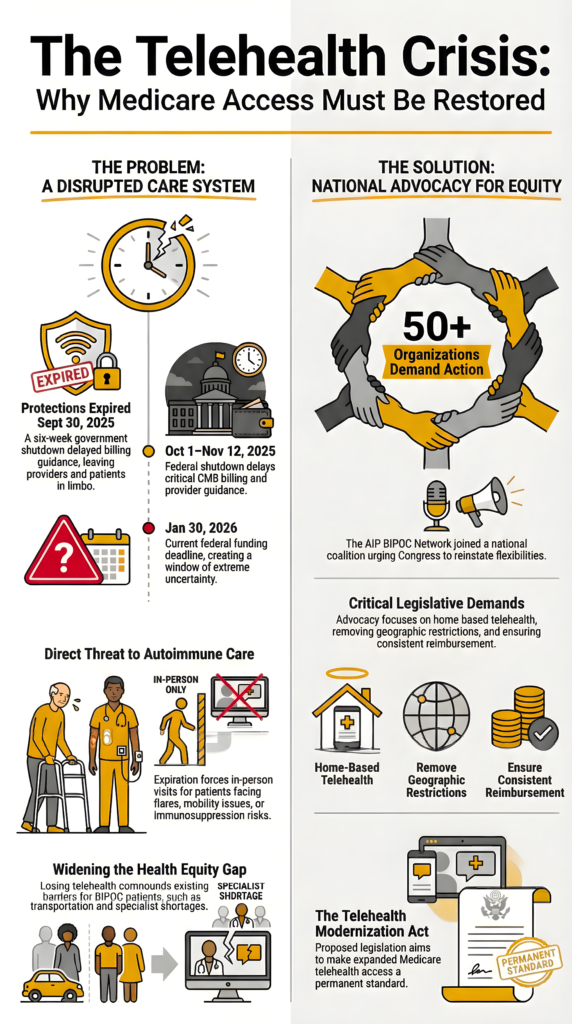
What Changed When Flexibilities Expired
During the pandemic, Medicare expanded telehealth access, allowing patients to receive care from home, reduce exposure risks, and connect with specialists.
These flexibilities supported:
- Virtual specialty visits from home
- Safe care for immunosuppressed patients
- Flexible scheduling
- Continuity of care
- Reduced transportation barriers
- Access for rural and underserved communities
All of that ended on September 30, 2025.
The timing created immediate disruption. The federal government shutdown began the next day, on October 1, delaying guidance and communication at a critical moment. The shutdown lasted six weeks, ending on November 12, 2025.
During this period:
- The Centers for Medicare & Medicaid Services (CMS), the federal agency responsible for Medicare coverage and payment policy, did not issue updated billing guidance
- Provider instructions stalled
- Critical clarifications were delayed
- Specialists lacked clear rules for telehealth use
- Some clinics reduced telehealth services due to uncertainty
Since then, clinics have been forced to make their own decisions without consistent federal guidance. Some continue telehealth. Others have scaled back. Many now require in-person visits again, even when patients are in flare cycles or unable to travel.
For autoimmune patients, this is not theoretical. It is immediate.
While access and implementation have varied across providers and regions, many patients and clinicians have experienced increased uncertainty and reduced consistency in telehealth availability.
Why This Hits Autoimmune and BIPOC Patients Hardest
Autoimmune disease already creates barriers to consistent care:
- Sudden flares that limit mobility
- Chronic pain and fatigue
- Increased infection risk due to immunosuppression
- The need for ongoing, multispecialty care
- Long wait times for rheumatology, GI, neurology, and dermatology
Telehealth was not just an option. For many, it was the only reliable way to stay connected to care.
For BIPOC patients, the impact is compounded. Longer diagnostic delays, fewer nearby specialists, transportation barriers, and systemic inequities already limit access to care. Telehealth has helped close some of these gaps. Losing it risks widening them again and pushing care further out of reach.
Where Things Stand Today
Right now, access to Medicare telehealth is inconsistent and unclear:
- Telehealth flexibilities have expired
- CMS has not issued full post-expiration guidance
- Providers are applying different rules across specialties
- Some clinics have already reduced telehealth services
- Certain specialists now require in-person visits for medication management and flare follow-ups
- Federal funding only extends through January 30, 2026, leaving continued uncertainty
What ABN Is Advocating For
Through its participation in the CCPA letter, ABN is supporting efforts to restore Medicare telehealth access and protect continuity of care for people living with chronic conditions.
More broadly, ABN continues to advocate for equitable access to care, including solutions that reduce barriers for individuals managing chronic and autoimmune conditions.
ABN is using its role in this coalition to ensure that underserved communities, including BIPOC populations, are represented in ongoing policy conversations about telehealth and access to care.
What We’re Watching Between Now and January
With CMS back in operation and Congress approaching the next funding deadline, several developments matter:
- Whether Congress temporarily reinstates telehealth
- Movement on the Telehealth Modernization Act
- CMS releasing overdue billing and coverage guidance
- Updates tied to the delayed 2026 Physician Fee Schedule
- New language in the January funding package that could restore protections
This is a critical window. Telehealth access could be restored, or scaled back further, depending on how these decisions unfold.
What Autoimmune Patients Can Do Now
You don’t have to wait for policy decisions to happen around you. Your voice matters.
- Read and share the Chronic Care Policy Alliance Joint Telehealth Letter
- Tell your specialists how the loss of telehealth is affecting your care
- Contact your lawmakers and speak to the impact on flares, mobility, and safety
- Document when in-person visits are unsafe or inaccessible
- Stay connected with ABN for updates as federal decisions unfold
- Share this blog so others understand what’s at stake
Policy feels abstract until it disrupts your care. For autoimmune patients, that disruption is already happening.
Final Thoughts
Telehealth gave patients a way to manage their conditions with more consistency, flexibility, and safety. Losing those protections has created a quiet but real access gap, especially for communities already facing barriers to care.
The CCPA coalition letter is not just advocacy. It reflects a coordinated demand for Congress to recognize the realities of chronic illness and restore access that patients rely on
ABN will continue working alongside national partners, tracking these developments, and making sure autoimmune and BIPOC communities remain part of the conversation.
Telehealth is not optional. It is essential care, and access to it should not be uncertain.
Frequently Asked Questions About Medicare Telehealth Access
What changed with Medicare telehealth in 2025?
Medicare telehealth flexibilities that allowed patients to receive care from home without geographic restrictions expired on September 30, 2025. Since then, access has become inconsistent, with some providers reducing or limiting virtual care.
Is telehealth still covered by Medicare right now?
Some telehealth services are still covered, but rules vary by provider and specialty. Without updated CMS guidance, many clinics are applying different policies, which can limit access.
Why is telehealth important for autoimmune patients?
Autoimmune conditions often involve unpredictable flares, fatigue, and mobility challenges. Telehealth allows patients to stay connected to care without risking exposure, travel strain, or missed appointments during symptom cycles.
How does losing telehealth affect BIPOC communities?
BIPOC patients already face longer diagnostic delays, fewer specialists, and transportation barriers. Telehealth helped reduce some of these gaps. Losing it makes access to care more difficult and less consistent.
What is the Telehealth Modernization Act?
The Telehealth Modernization Act is proposed federal legislation that aims to make certain Medicare telehealth flexibilities permanent, including expanded access from home and fewer geographic restrictions.
What is the Chronic Care Policy Alliance (CCPA) letter?
The CCPA letter is a joint advocacy effort signed by over 50 organizations, including ABN, urging Congress to restore and extend Medicare telehealth access for people with chronic conditions.
What can patients do if telehealth access is reduced?
Patients can talk to their providers about options, document barriers to in-person care, contact lawmakers, and stay connected to advocacy organizations like ABN for updates and action steps.
Will Medicare telehealth access be restored?
It is not guaranteed. Ongoing federal negotiations, including funding deadlines and proposed legislation, will determine whether telehealth access is reinstated, limited, or expanded.
References
Chronic Care Policy Alliance. Joint Organizational Letter on Medicare Telehealth Access, 2025.
CCPA Leads Sign-On Letter Urging Congress to Reinstate Medicare Telehealth Flexibilities
Centers for Medicare & Medicaid Services (CMS). Medicare Telehealth Updates & 2025 Policy Guidance.
View Medicare Telehealth Coverage Guidance
U.S. Department of Health & Human Services. Telehealth Policy Updates, 2025.
View Telehealth Policy Updates
National Library of Medicine (NIH). Barriers and Telehealth Access for Chronic Illness Patients.
Read the Research Article
AP News. Shutdown Ends After Six Weeks as Congress Passes Funding Bill.
Read the Article
Rep. Buddy Carter. Telehealth Congressional Commentary & Policy Statements.
View Policy Statement
About the AIP BIPOC Network
The AIP BIPOC Network (ABN) is a nonprofit organization focused on improving awareness, advocacy, and education around autoimmune disease and chronic illness.
ABN operates through a Dual Framework that addresses both systemic and individual drivers of health.
At the systems level, ABN advances access, inclusion, and prevention by elevating community voices in healthcare policy, research, and public health conversations.
At the individual level, ABN promotes education around nutrition, lifestyle, and functional wellness approaches, including principles from the Autoimmune Protocol and nutrient-dense dietary strategies that support immune health.
Through community programs, partnerships, education initiatives, and advocacy efforts, ABN works to bridge lived experience, research, and policy to improve outcomes for people living with autoimmune disease and chronic illness.
Explore ABN programs and advocacy initiatives to learn how the organization is advancing autoimmune awareness and health equity.

Jamie Nicole is the Founder and CEO of The AIP BIPOC Network. She is a Certified AIP Coach, patient advocate, and fitness instructor living with multiple autoimmune conditions. Jamie is committed to advancing equity, access, and representation for Black, Indigenous, and People of Color navigating autoimmune and chronic illness. Through education, advocacy, movement, and community-driven initiatives, she works to ensure BIPOC voices are centered in healthcare conversations and solutions.
Leave a Reply


© 2026 The AIP BIPOC Network, INc | EIN # 92-2526059 | all rights reserved | legal
