




Autoimmune disease affects more than 50 million Americans, yet it remains one of the most underfunded and fragmented areas in public health.
For people living with autoimmune disease and chronic illness, this shows up in delayed diagnoses, limited access to specialists, high treatment costs, and gaps in research.
Addressing these challenges requires more than care. It requires policy.
Key Takeaways
- Autoimmune disease impacts 50+ million Americans but receives a disproportionately small share of federal research funding
- The Legislative Fly-In connects advocates directly with Congress to address research, access, and affordability
- The AIP BIPOC Network (ABN) is participating for the third consecutive year
- 2026 priorities include OADR, step therapy reform, copay accumulator policies, and 340B protections
- Policy decisions directly impact diagnosis timelines, treatment access, and out-of-pocket costs
- Individuals can engage through advocacy, Civic Score and voter access tools like Vot-ER
Why Autoimmune Disease Advocacy Is Urgent
Despite its prevalence, autoimmune disease receives less than 3 cents of every NIH dollar.
Funding per patient is significantly lower than for other major diseases such as cancer and diabetes, even as autoimmune conditions continue to rise.
This gap has real consequences:
- Research remains fragmented across more than 100 conditions
- Early detection tools and standardized pathways are limited
- Patients often spend years navigating diagnosis and treatment
Other disease areas have benefited from coordinated federal strategies and sustained investment.
Autoimmune disease has not.
This is why advocacy matters.
It is not only about increasing funding. It is about ensuring that funding is coordinated, strategic, and aligned with the scale of the problem.
Autoimmune disease is not rare. It is under-prioritized.
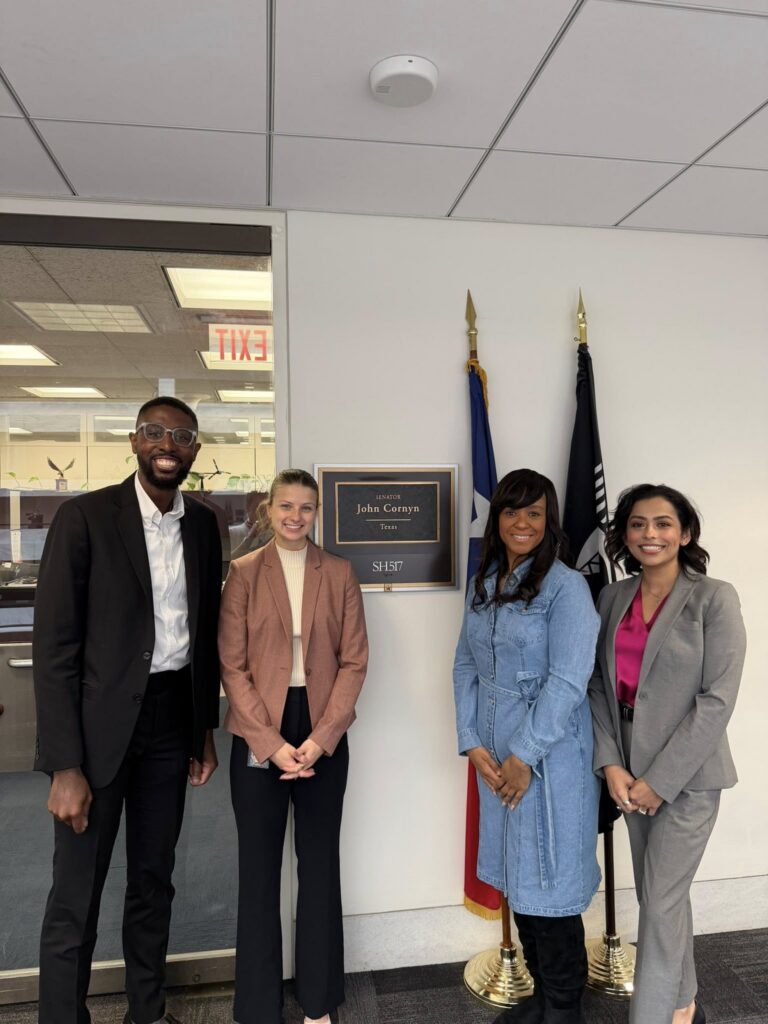
ABN at the Autoimmune Association Legislative Fly-In
Each year, the Autoimmune Association convenes advocates in Washington, DC to meet directly with members of Congress and their staff.
I first attended the Autoimmune Association Virtual Legislative Fly-In in 2023 as a patient. I continue to participate, bringing both lived experience and the perspective of my work through The AIP BIPOC Network into conversations with policymakers.
Advocates are organized by state and meet with their respective congressional offices in coordinated groups.
This structure aligns messaging while bringing multiple perspectives into each conversation.
In 2026, approximately 40 advocates are participating in the Fly-In in Washington, DC.



How Legislative Fly-Ins Drive Policy Change
Autoimmune disease is often treated as separate conditions across specialties. Policy follows that same fragmentation.
Without coordination:
- Research funding is spread across institutes without alignment
- Access barriers are addressed inconsistently
- Cost challenges are handled in isolation
Legislative fly-ins bring these issues together.
They connect lived experience, clinical gaps, and policy decisions in real time.
Across multiple meetings, cost-related barriers and delays in treatment access were consistently raised in conversations with congressional offices.
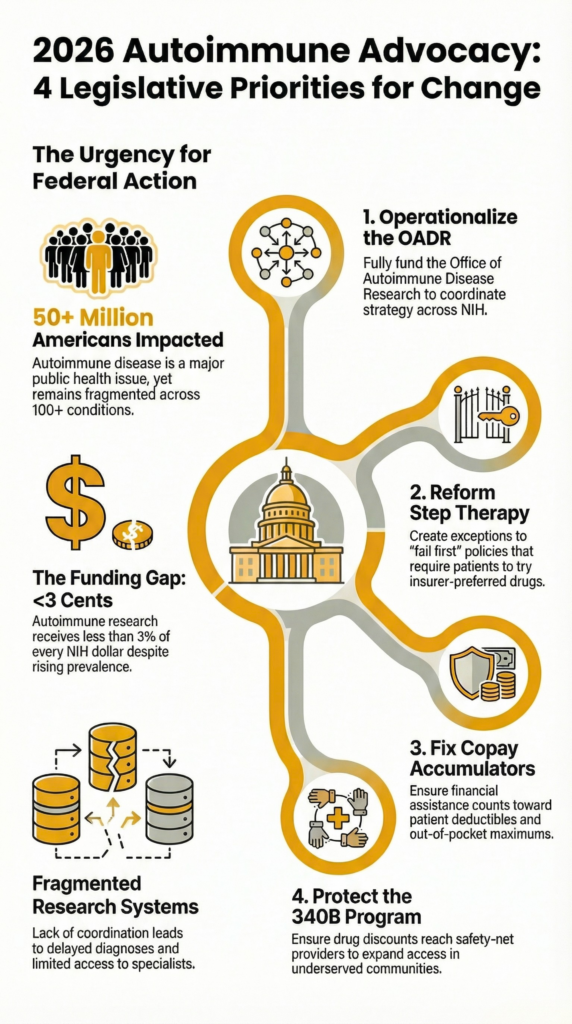
2026 Federal Advocacy Priorities
The Legislative Fly-In is focused on specific policy areas that directly impact research coordination, treatment access, and affordability for people living with autoimmune disease.
In 2026, these priorities reflect both long-standing gaps in the system and areas where federal action can improve outcomes.
1. Office of Autoimmune Disease Research
Given the scale of autoimmune disease and the funding gap, coordination is as critical as investment.
The Office of Autoimmune Disease Research (OADR) was established within NIH to align research across conditions and create a unified strategy.
OADR focuses on:
- Developing a national autoimmune research strategy
- Identifying gaps across diseases
- Coordinating efforts across NIH institutes
- Supporting shared data infrastructure
The structure exists. The challenge is ensuring it is fully funded and operationalized.
2. Step Therapy Reform
Step therapy, or “fail first,” requires patients to try insurer-preferred medications before accessing prescribed treatment.
For autoimmune patients, this can lead to:
- Delays in effective care
- Worsening disease activity
- Increased administrative burden
Policy efforts focus on creating clear exceptions processes, setting response timelines, and allowing providers to override step therapy when medically necessary.
3. Copay Accumulator and Maximizer Programs
These programs prevent financial assistance from counting toward deductibles and out-of-pocket maximums.
In practice:
- Assistance is used early but does not reduce patient responsibility
- Patients face full costs later in the year
- Treatment interruptions become more likely
Policy solutions aim to ensure financial assistance actually reduces patient burden.
4. 340B Program
The 340B program allows safety-net providers to purchase medications at reduced cost and expand access to care.
For autoimmune patients, this supports:
- Access to high-cost medications
- Continuity of care in underserved communities
- Expanded services through community providers
Current discussions focus on transparency, accountability, and ensuring savings reach patients. Policy priorities set the direction, but sustained change depends on continued engagement beyond these meetings.
Powering Advocacy: From Policy to Civic Action
Policy discussions do not end in Washington, DC. They shape how people experience care, cost, and access every day.
Advocacy also does not end at a Legislative Fly-In.
If you are navigating autoimmune disease or chronic illness, your experience is part of how these issues are understood and addressed.
There are multiple ways to engage:
- Participate civically to help shape the policies that impact healthcare access and affordability through tools like Vot-ER
- Understand the system through CivicScore, which connects policy decisions to real-world impact on autoimmune and chronic illness care
- Share your experience to highlight where systems are not working and why change is needed
Together, these components create a clear pathway:
Lived Experience → Understanding → Participation → Policy Change
Advocacy is not just about being heard. It is about making systems respond.
Frequently Asked Questions
Why are autoimmune diseases increasing?
Autoimmune diseases are rising due to a combination of environmental factors, improved detection, and ongoing gaps in research and prevention.
At the same time, limited coordination across conditions makes it harder to fully understand and address the root causes, reinforcing the need for a more unified research strategy.
Why is autoimmune disease underfunded compared to other conditions?
Autoimmune disease has historically been treated as a collection of separate conditions rather than a unified public health issue. This fragmentation affects how research is funded and prioritized.
While autoimmune disease impacts more than 50 million Americans, funding is spread across multiple institutes and conditions without consistent coordination. In contrast, diseases like cancer and HIV benefit from centralized strategies, dedicated infrastructure, and sustained federal investment.
Addressing this gap requires both increased funding and coordinated approaches through structures like the Office of Autoimmune Disease Research (OADR).
Why is autoimmune disease a policy issue?
Autoimmune disease is shaped by how systems are designed, not just how care is delivered. Research funding levels, insurance policies like step therapy, access to specialists, and medication affordability are all determined by policy decisions.
Without policy change, gaps in diagnosis, treatment, and research coordination persist regardless of clinical advances.
What does the Legislative Fly-In accomplish?
The Fly-In creates direct engagement between advocates and congressional offices, allowing policymakers to hear how system-level gaps show up in real life.
These conversations influence how issues are prioritized, how funding decisions are approached, and how policies are shaped over time. It reinforces that autoimmune disease requires a coordinated, national response.
How does OADR improve research?
OADR addresses fragmentation by coordinating research across conditions and NIH institutes. It helps identify shared mechanisms, close gaps across diseases, and support a more unified research strategy.
This improves efficiency, reduces duplication, and creates a clearer pathway for advancing diagnosis and treatment.
Why is step therapy reform important?
Step therapy can delay access to effective treatment by requiring patients to try and fail on insurer-preferred medications first.
For autoimmune conditions, these delays can lead to disease progression, increased complications, and reduced quality of life. Reform focuses on restoring timely access and allowing providers to make decisions based on medical necessity.
How do copay accumulator programs affect patients?
Copay accumulator and maximizer programs prevent financial assistance from counting toward deductibles and out-of-pocket maximums.
This increases out-of-pocket costs and creates financial strain, particularly for individuals managing chronic conditions that require ongoing treatment. It can also lead to treatment interruptions and reduced adherence to care.
Why is the 340B program important?
The 340B program supports access to medications and services through safety-net providers serving underserved communities.
For autoimmune patients, this can determine whether treatment is accessible and sustainable. Protecting the program helps ensure that cost savings are used to expand care where access is already limited.
How can individuals get involved?
Advocacy can take multiple forms. Individuals can share their lived experience in ways that highlight system-level barriers, engage with policymakers, use tools like CivicScore to understand how decisions are being made, and participate in civic processes.
Collective participation strengthens how these issues are recognized and addressed.
About the AIP BIPOC Network
The AIP BIPOC Network (ABN) is a nonprofit organization focused on improving awareness, advocacy, and education around autoimmune disease and chronic illness.
ABN operates through a Dual Framework that addresses both systemic and individual drivers of health.
At the systems level, ABN advances access, inclusion, and prevention by elevating community voices in healthcare policy, research, and public health conversations.
At the individual level, ABN promotes education around nutrition, lifestyle, and functional wellness approaches, including principles from the Autoimmune Protocol and nutrient-dense dietary strategies that support immune health.
Through community programs, partnerships, education initiatives, and advocacy efforts, ABN works to bridge lived experience, research, and policy to improve outcomes for people living with autoimmune disease and chronic illness.
Explore ABN programs and advocacy initiatives to learn how the organization is advancing autoimmune awareness and health equity.

Jamie Nicole is the Founder and CEO of The AIP BIPOC Network. She is a Certified AIP Coach, patient advocate, and fitness instructor living with multiple autoimmune conditions. Jamie is committed to advancing equity, access, and representation for Black, Indigenous, and People of Color navigating autoimmune and chronic illness. Through education, advocacy, movement, and community-driven initiatives, she works to ensure BIPOC voices are centered in healthcare conversations and solutions.
Leave a Reply


© 2026 The AIP BIPOC Network, INc | EIN # 92-2526059 | all rights reserved | legal
