

Programs Overview
Past Events
ROCK Weekend
Upcoming Events
Blog
Resource Hub
Sponsor
Volunteer
Partner with Us
Ways to Support
Share Your Story
Join Our Network
Our Impact
Why BIPOC?
Our Approach
Who We Are
Common Questions
Community Care Collaborative
ROCK it Wellness
The AIP BIPOC Community
The AIP BIPOC Roundtable
Powering Advocacy


Across the country, people are feeling stretched. The cost of living is rising, access to healthcare is uneven, and policy decisions often feel disconnected from everyday reality. Even when headlines suggest stability, daily life can feel harder than it should.
At The AIP BIPOC Network (ABN), we hear this every day. Communities know something is wrong long before it shows up in official reports. What’s often missing is a clear way to explain why things feel so difficult and what is actually driving that pressure.
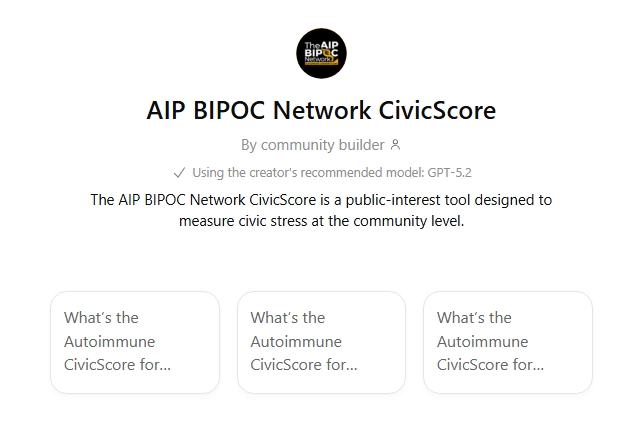
That belief led to the creation of the AIP BIPOC Network Autoimmune CivicScore GPT (CivicScore GPT), an AI-powered public-interest tool developed in partnership with Cynthia Adinig, founder of CYNAERA. While it is centered on autoimmune disease and lived experience, the tool can also be used to explore broader civic conditions. The goal is simple: help communities see, understand, and talk about the civic stress and autoimmune-related pressures shaping their lives.
The Autoimmune CivicScore GPT was created to help communities understand why civic stress, autoimmune disease burden, and daily life pressures can feel so overwhelming even when conditions look stable on paper. This is not AI for automation or hype. It is AI for understanding.
From Powering Advocacy to CivicScore GPT
The Autoimmune CivicScore GPT is a direct extension of ABN’s Powering Advocacy program. Powering Advocacy connects lived experience to policy, research, and civic systems so communities impacted by autoimmune disease and access barriers are represented in decisions that shape care, funding, and public policy.
The CivicScore GPT translates that work into an AI-powered format. Instead of relying on workshops, spreadsheets, or technical expertise, communities can access the same advocacy logic through conversation. The tool centers lived experience, corrects for what is often undercounted, and makes civic pressure legible without flattening complexity.
In this way, the CivicScore GPT is not separate from ABN’s work. It is the digital evolution of Powering Advocacy, designed to scale access while preserving equity, context, and community voice.
Why This Matters to ABN
The Autoimmune CivicScore GPT reflects ABN’s mission to center autoimmune lived experience in civic data and public understanding. At ABN, we know lived experience often shows up before it appears in data, especially for BIPOC communities, disabled adults, and people living with autoimmune disease and related access challenges.
When patterns are finally named, people stop blaming themselves for conditions shaped by systems. That shift matters.
The CivicScore exists to help make those patterns visible and to support clearer, more honest civic conversations rooted in reality.
Why Lived Experience Often Goes Uncounted
In today’s civic landscape, there is a growing disconnect between official headlines that signal “stability” and what people are actually experiencing day to day. Economic reports may point to growth, and policy updates may suggest progress, yet many households are feeling stretched thinner than ever.
For people managing chronic illness, disability, or rising healthcare costs, stability can feel like an abstract concept rather than a lived reality. Traditional data tools often miss these pressures because they rely on narrow indicators that overlook underdiagnosis, unequal access to care, and the everyday tradeoffs people are forced to make just to get by.
When lived experience goes uncounted, trust erodes. Communities feel unseen by the systems meant to support them. The Autoimmune CivicScore GPT exists to help bridge that gap by translating invisible strain into civic signals that people can recognize, understand, and talk about together.
Making the Invisible Visible
Much of the burden shaping daily life sits below the surface of official counts. Undiagnosed and underdiagnosed conditions, especially in communities with limited access to care, create invisible strain that rarely shows up in traditional data.
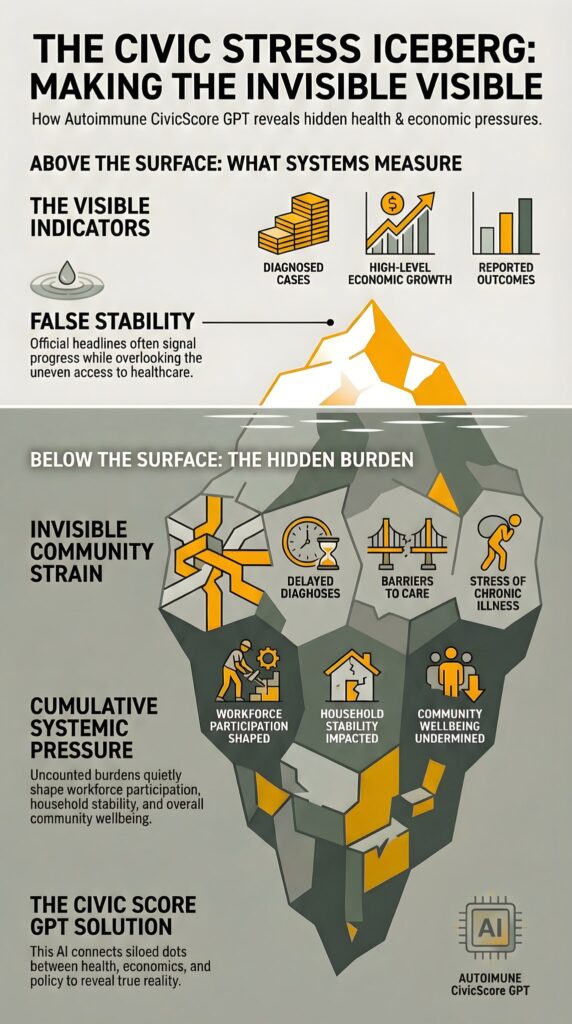
What appears above the surface in this visual represents what systems typically measure: diagnosed cases, reported outcomes, and high-level indicators of stability. What lies beneath reflects the lived reality of communities, including delayed diagnosis, barriers to care, chronic illness management, and the cumulative stress of navigating health alongside economic pressure.
That hidden burden does not disappear simply because it is uncounted. Instead, it accumulates quietly, shaping workforce participation, household stability, caregiving demands, and overall community wellbeing.
The partnership between CYNAERA and The AIP BIPOC Network exists to bring those patterns into view. CYNAERA provides the analytic capability to surface what traditional data misses, while ABN ensures those insights are grounded in community context and used to support understanding, not abstraction.
The Autoimmune CivicScore GPT is the result of that work. It turns what has long been invisible into something legible, helping communities name what they are experiencing and creating a shared reference point for more honest civic conversation.
Why AI Matters for Community Understanding
Too often, civic data is fragmented. Health is discussed separately from economics. Policy is evaluated without accounting for chronic illness or disability. Communities most affected by these overlaps are frequently undercounted or overlooked.
Responsible, human-centered AI offers a way to connect these dots.
Not by replacing people or automating decisions, but by identifying patterns that are difficult to see when systems are siloed and incomplete.
The Autoimmune CivicScore GPT uses analytic frameworks to surface patterns that reflect real-world burden rather than only what is easiest to measure. ABN’s role is to ensure those insights stay grounded in equity, accessibility, and community relevance.
This is AI designed to support clarity, not obscure it.
What the Autoimmune CivicScore GPT Helps Communities See
The Autoimmune CivicScore GPT answers a simple but important question:
How hard is it right now for people in a community to live, work, and manage health?
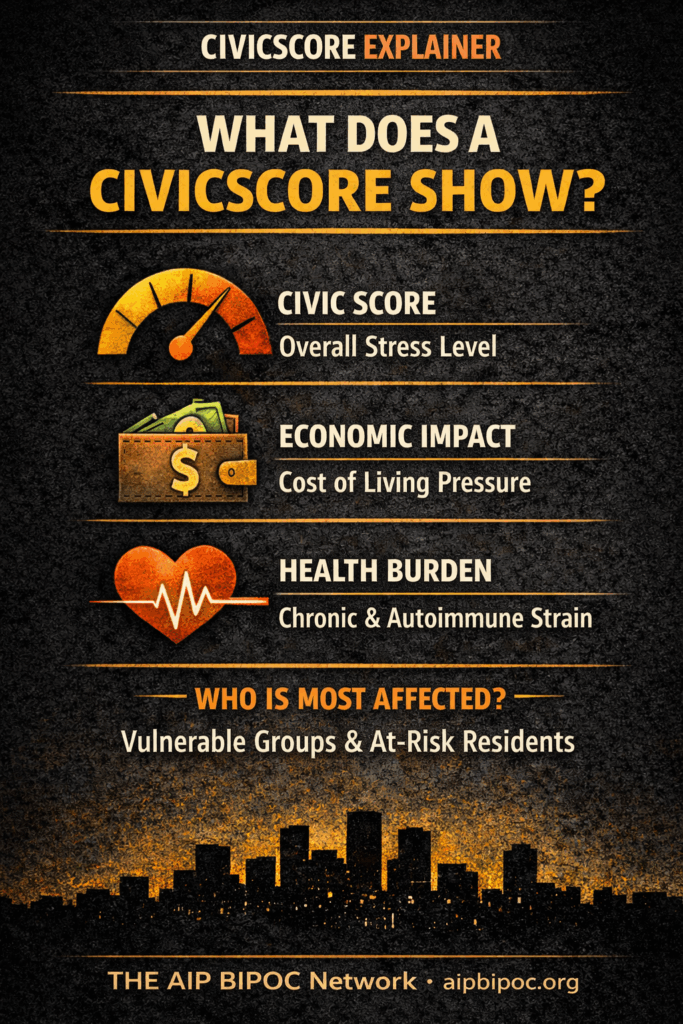
To answer that, it brings together signals that are usually discussed separately, including:
- Economic pressure and cost of living
- Government actions that affect access and stability
- Community wellbeing and civic risk
- The often invisible impact of chronic and autoimmune illness
Rather than rankings or predictions, the Autoimmune CivicScore provides context. It helps explain why stress is rising, who is most affected, and why daily life can feel harder even when conditions appear stable on the surface.
The goal is recognition. When people see their lived experience reflected, they gain language for what they already know.
From Insight to Action: Built-In Sharing Tools
Understanding civic conditions is only part of the equation. Sharing that understanding is how conversations begin and spread.
After generating a CivicScore, you can ask the GPT for different kinds of outputs depending on what you need next:
- Plain-language social media posts you can copy and paste
- Ready-to-share graphics that summarize key findings
- Short explainers and summaries for everyday readers, meetings, newsletters, or email
- Handouts and talking points to support community conversations
These features make it easier for community members, advocates, and organizations to share insights without needing design or data expertise, turning information into a conversation tool.
What the CivicScore GPT Produces: Real Examples You Can Share
When you request your CivicScore, you are not limited to a single number or summary.
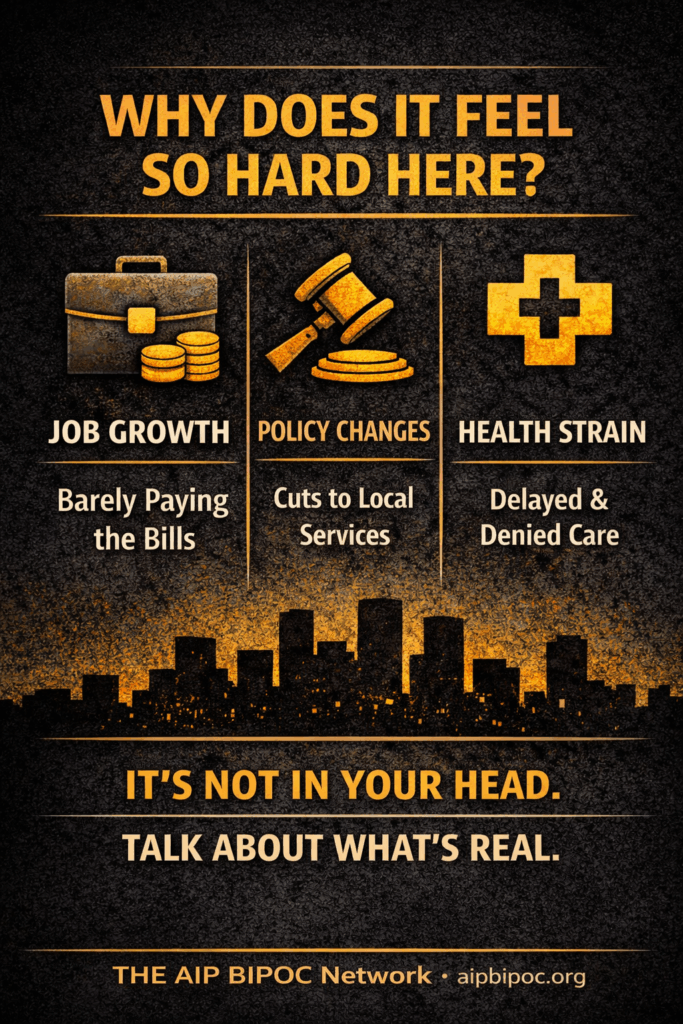
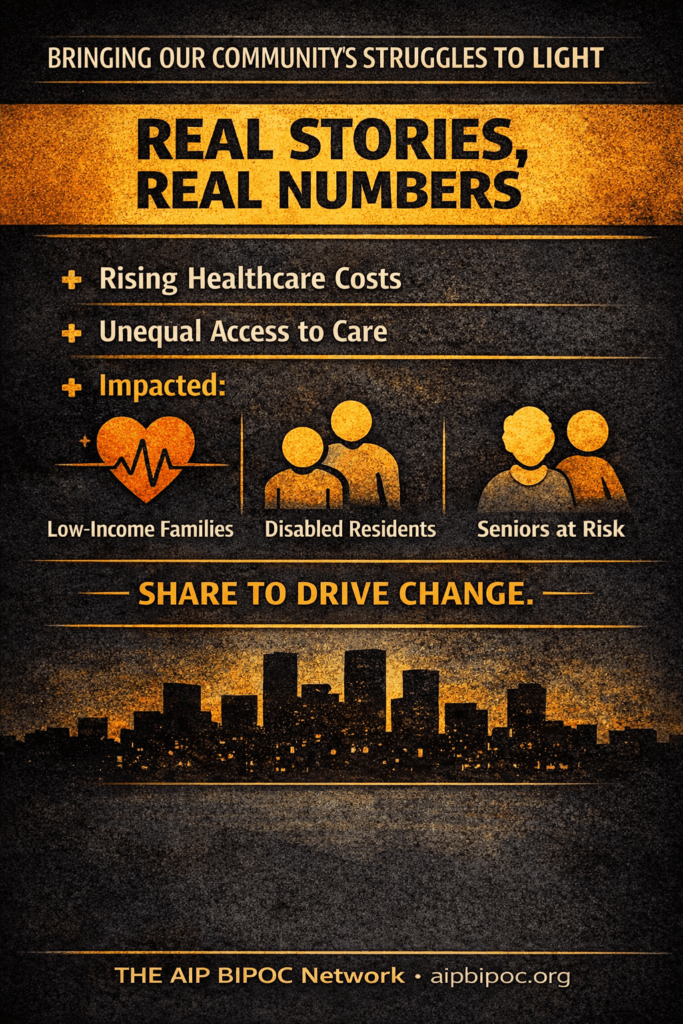
You can ask the CivicScore GPT to generate shareable graphics and explainers that help make sense of what is happening in your community. These visuals are designed to translate layered civic conditions into something people can recognize and talk about.
Research consistently shows that people are more likely to understand, remember, and act on information when it is presented visually rather than buried in reports. This is especially true for complex issues like health burden, economic strain, and policy impact, where the effects are cumulative and not always immediately visible.
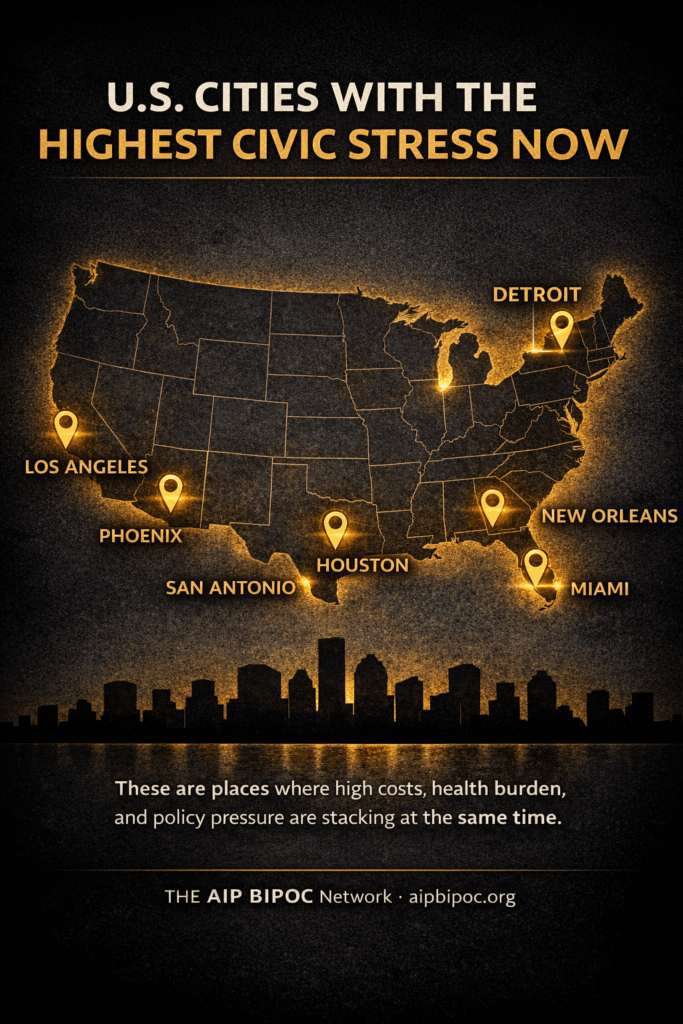
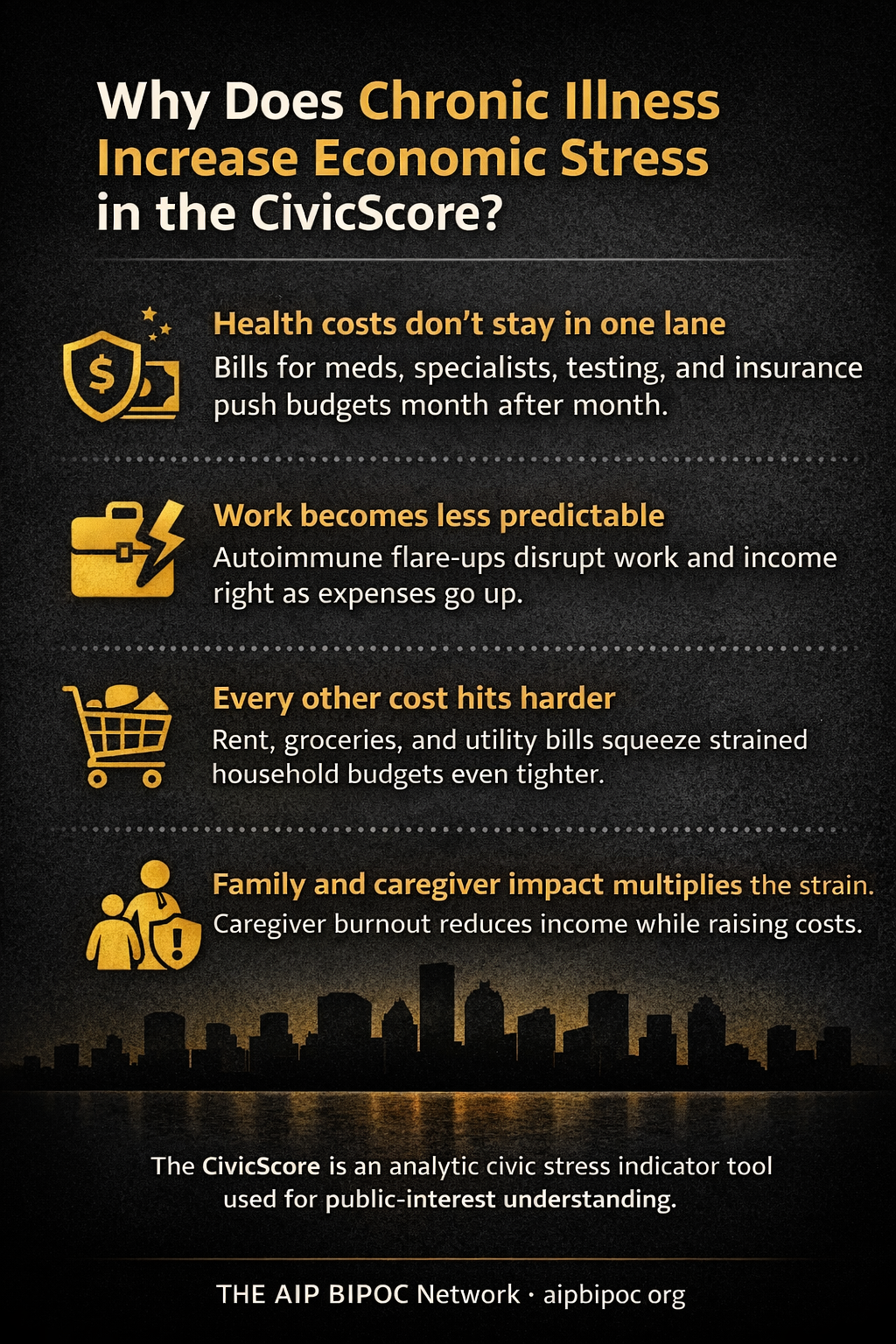
Instead of abstract data points, the graphics show how multiple pressures are interacting at the same time. Rising costs, limited access to care, and chronic or autoimmune illness often reinforce one another. Seeing those connections visually helps explain why daily life can feel harder even when conditions appear stable on paper.
This matters because data that stays buried in reports rarely changes anything. Data that people can see, recognize, and share is far more likely to spark conversation, understanding, and action.
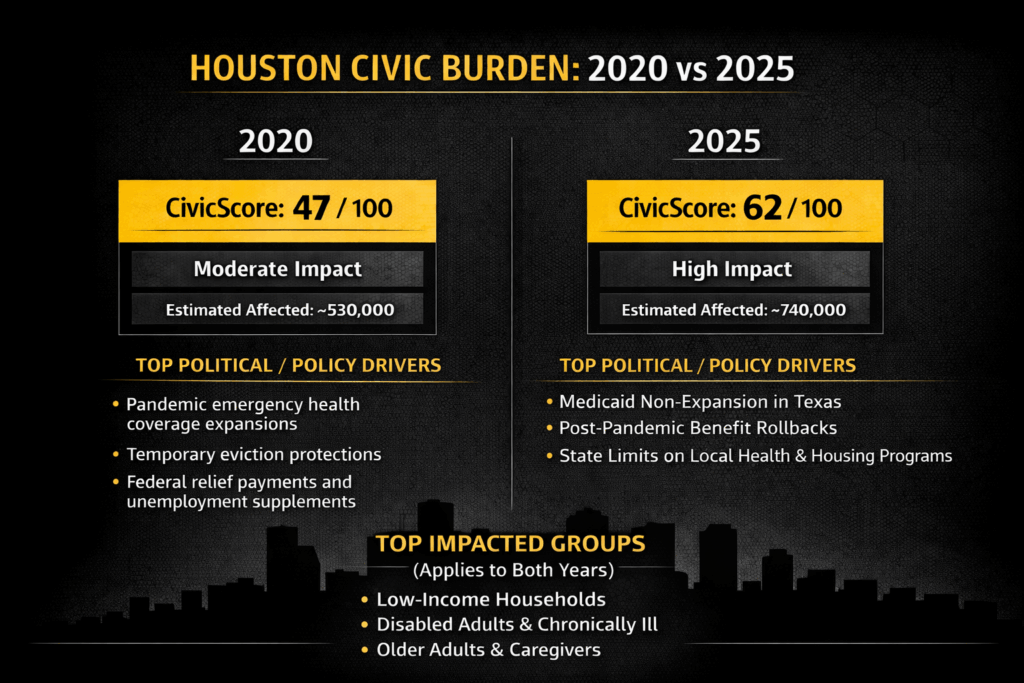
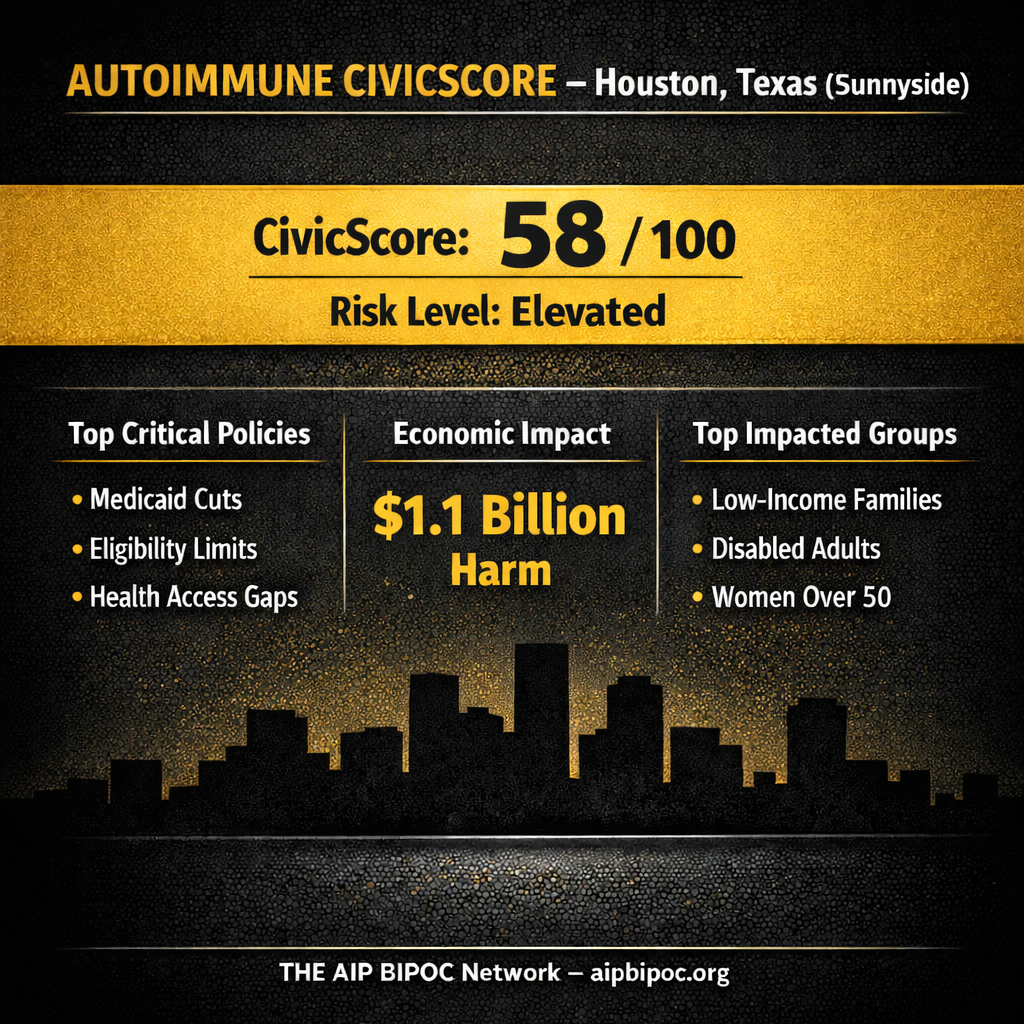
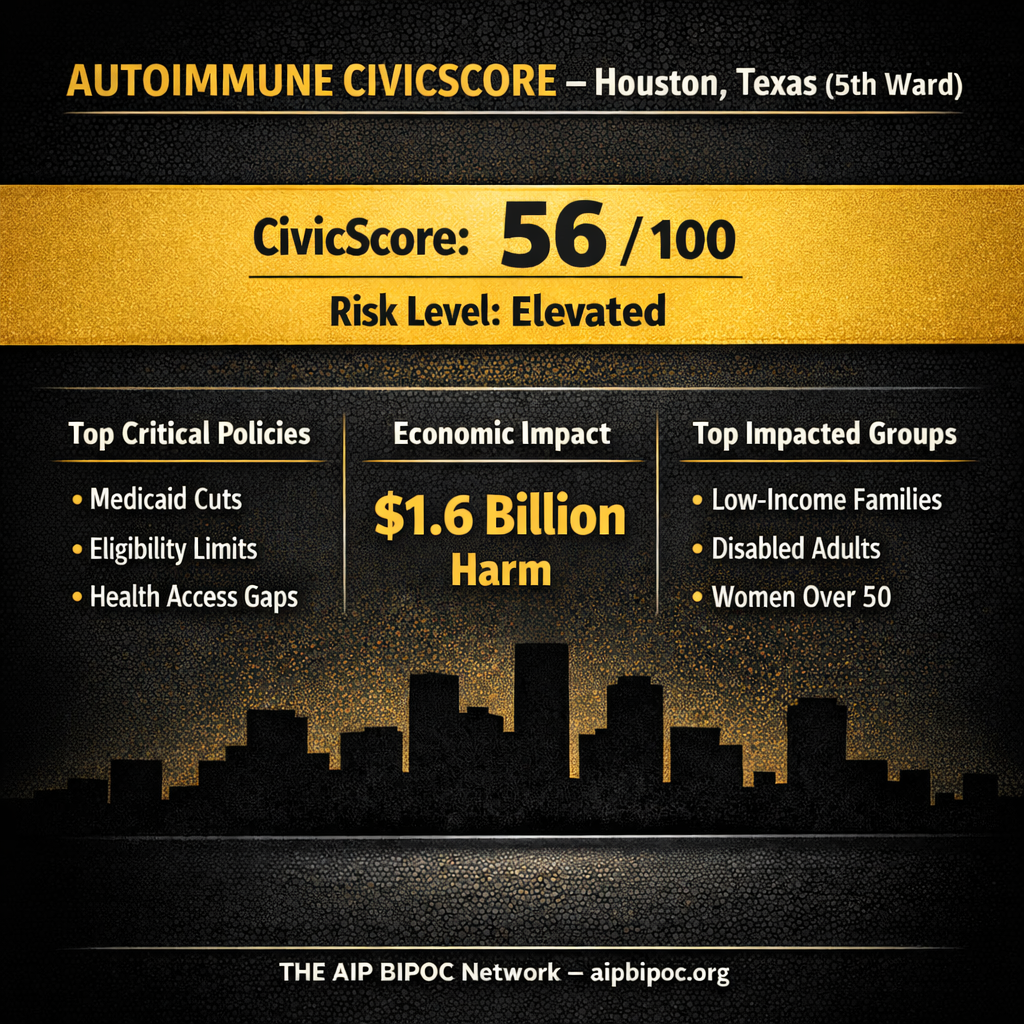
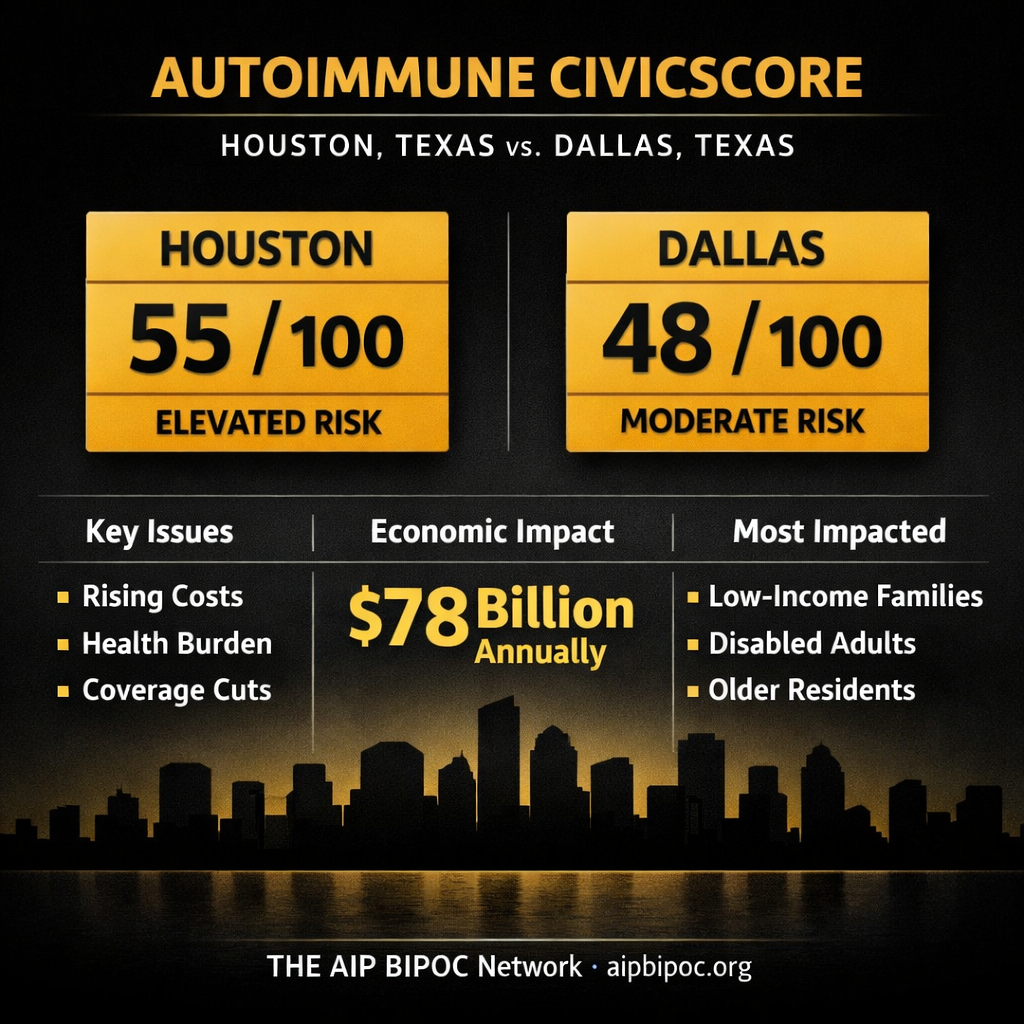
These visuals are designed to support shared understanding. They give communities a common reference point that can be used in conversations, meetings, or outreach, without relying only on personal stories.
Below are additional examples of how CivicScore insights can be visualized to answer common questions people ask about their communities.
Try the Autoimmune CivicScore GPT
The Autoimmune CivicScore GPT is publicly available and designed for everyday use.
You can ask about a city or community, receive a CivicScore, and then continue the conversation by asking follow-up questions, requesting explanations, or generating posts, graphics, and other materials to help you understand and share what is happening in your community.
If you are not sure where to start, ABN has created a short guide with example questions you can use with the CivicScore GPT. These examples show how to explore community conditions in plain language, without technical expertise, and how to go deeper after you receive a score.
The examples can help you:
- Request a CivicScore for a city, neighborhood, or ZIP code
- Understand what is driving civic stress or health burden
- Explore how autoimmune disease, access to care, cost of living, and policy pressures interact
- Ask follow-up questions about who is most affected and why
- Generate explanations, graphics, posts, or handouts you can share with others
These examples are meant to be flexible starting points. You can copy them directly, adapt them to your situation, or use them as inspiration for your own questions.
Use the CivicScore GPT here: The Autoimmune CivicScore GPT
Frequently Asked Questions
Is the Autoimmune CivicScore GPT a medical or diagnostic tool?
No. The Autoimmune CivicScore GPT does not provide medical advice or diagnoses. It focuses on community-level conditions, including autoimmune disease burden, access to care, cost-of-living pressure, and policy impacts that shape daily life.
Why does the CivicScore center autoimmune disease?
Autoimmune conditions are frequently underdiagnosed, undercounted, and deeply affected by policy, access barriers, and economic stress. ABN centers autoimmune lived experience because these realities are often missing from public data and civic decision-making.
Can the CivicScore GPT be used for non-autoimmune questions?
Yes. While the Autoimmune CivicScore GPT centers autoimmune disease as a critical lens, it can also be used to explore broader civic stress, economic pressure, policy impacts, and community wellbeing even when a question is not specifically about autoimmune conditions.
Do I need technical or data expertise to use the CivicScore GPT?
No. The tool is designed for everyday use. You can ask about a community in plain language and receive explanations, summaries, and visuals without technical skills.
Can I share what the CivicScore GPT produces?
Yes. You can request plain-language posts, shareable graphics, explainers, and handouts to use in conversations, advocacy, newsletters, or social media.
Who is this tool for?
The CivicScore GPT is for community members, people living with autoimmune disease, caregivers, advocates, organizers, and organizations seeking to understand and communicate civic stress.
Why does my community’s CivicScore look the way it does?
After receiving a CivicScore, you can ask follow-up questions to explore which factors are driving stress, who is most affected, and how health, economic, and policy pressures interact.
Join the Conversation
The Autoimmune CivicScore GPT is a living public-interest tool that will continue to evolve through community use and feedback.
If you try it, tell us what you think. What resonated? What felt missing? How could it better support your community?
Share your thoughts in the comments below. Your feedback helps shape how this tool evolves and how AI can better serve the public good.
Support the Work Behind the CivicScore
The Autoimmune CivicScore GPT exists because ABN has invested in long-term advocacy infrastructure through its Powering Advocacy Program.
This work takes time, care, and resources. From research and community engagement to maintaining public-interest tools that remain accessible and free to use, Powering Advocacy makes it possible to turn lived experience into civic insight.
If this tool helped you better understand your community, supported your advocacy, or gave language to something you’ve been feeling, consider supporting the work behind it.

Support the Powering Advocacy Program:
www.aip-bipoc-network-giving.causevox.com/d/Powering-Advocacy
Your support helps ensure this work remains available, accountable, and centered on community needs.

Leave a Reply


Programs Overview
Past Events
ROCK Weekend
Upcoming Events
Blog
Resource Hub
Sponsor
Volunteer
Partner with Us
Ways to Support
Share Your Story
Join Our Network
Our Impact
Why BIPOC?
Our Approach
Who We Are
Common Questions
Community Care Collaborative
ROCK it Wellness
The AIP BIPOC Community
The AIP BIPOC Roundtable
Powering Advocacy
© 2026 The AIP BIPOC Network, INc | EIN # 92-2526059 | all rights reserved | legal
Great tool