

Programs Overview
Past Events
ROCK Weekend
Upcoming Events
Blog
Resource Hub
Sponsor
Volunteer
Partner with Us
Ways to Support
Share Your Story
Join Our Network
Our Impact
Why BIPOC?
Our Approach
Who We Are
Common Questions
Community Care Collaborative
ROCK it Wellness
The AIP BIPOC Community
The AIP BIPOC Roundtable
Powering Advocacy

Voting is not usually framed as a health issue. It should be.
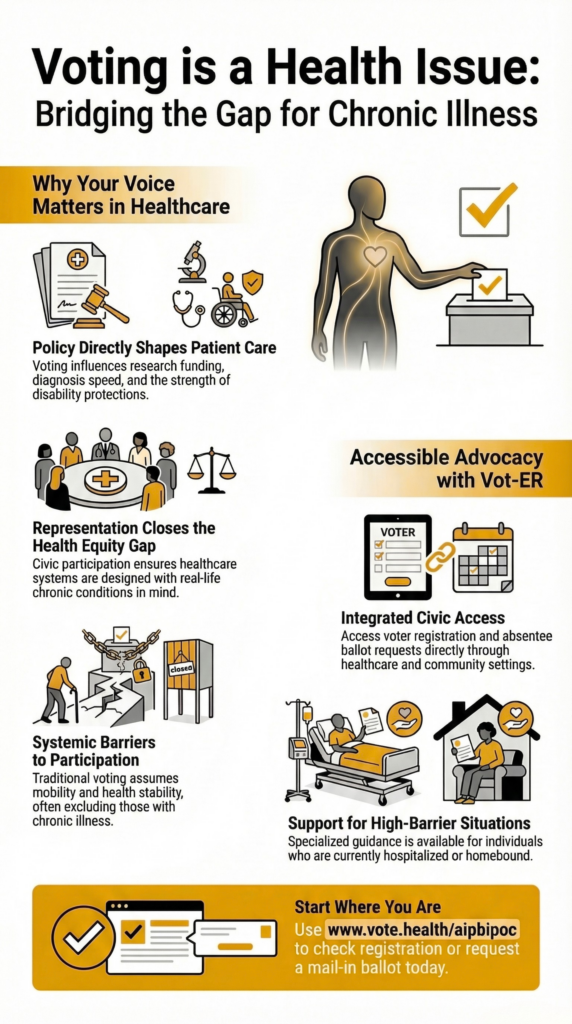
Healthcare access, research funding, disability protections, and public health priorities are shaped by policy. Those policies determine who gets care, how quickly people are diagnosed, and which communities receive investment. Policy, in turn, is shaped by who participates.
The AIP BIPOC Network is a Vot-ER partner, working to make civic participation more accessible for people living with chronic illness.
Key Takeaways
- Voting directly influences healthcare access, research funding, and health equity
- People living with chronic illness face real, health-related barriers to civic participation
- Vot-ER integrates voter access into healthcare settings
- Tools include guidance for people who are hospitalized, homebound, or managing limited mobility
- The AIP BIPOC Network incorporates this into its Powering Advocacy work
Why This Matters
People living with chronic illness experience consistent gaps across the healthcare system. Diagnosis can take years, access to specialists is uneven, and research often lacks representation from the very communities most impacted. Care is not always culturally responsive, and support systems are not always designed with real-life conditions in mind.
These are not isolated challenges. They reflect how healthcare systems are built, how research priorities are set, and how funding is distributed. Each of these areas is influenced by policy decisions.
Civic participation plays a role in shaping those decisions. When people navigating chronic illness are underrepresented in civic processes, their experiences are less likely to be reflected in the systems designed to support them.
Removing Barriers to Participation
Traditional voting systems are built around the assumption that people can show up in person, wait in line, and navigate multiple steps without interruption.
That model does not reflect the reality of chronic illness, where fatigue, flares, mobility limitations, caregiving responsibilities, and unexpected medical needs can make participation difficult or inconsistent.
For many people, the barrier is not willingness to participate. It is whether participation is accessible at all.
Vot-ER was designed with these realities in mind. It integrates civic engagement into healthcare and community spaces, making voter access part of the broader health experience rather than a separate process people have to navigate on their own.
Through Vot-ER, individuals can:
- Check voter registration status
- Register to vote
- Request mail-in or absentee ballots
- Access state-specific guidance for voting while hospitalized
- Find options for voting when homebound or managing limited mobility
Start here:
www.vote.health/aipbipoc
By meeting people where they are, including during moments of care or recovery, Vot-ER removes barriers that would otherwise prevent participation.
Where This Fits in Our Work
At The AIP BIPOC Network, this effort is part of Powering Advocacy, our program focused on civic engagement and policy awareness.
As a Vot-ER community partner, we are not just sharing a resource. We are intentionally integrating civic access into health-centered community work. This approach recognizes that improving health outcomes is not only about care delivery, but also about ensuring communities are represented in the systems that shape that care.
This work connects to our broader focus on access, inclusion, and prevention.
Whether through community programming, partnerships, or advocacy efforts, the goal is consistent: reduce barriers and increase representation for people living with chronic illness.
What Participation Changes
When people living with chronic illness participate in civic processes, it influences more than a single election. It shapes the broader environment in which healthcare decisions are made.
Participation can impact:
- How research funding is allocated
- Who is included in clinical studies
- How healthcare systems prioritize access and delivery
- The strength of disability and workplace protections
- Investment in community-based health resources
These outcomes are directly tied to policy decisions. Civic participation helps ensure those decisions reflect real experiences.
Start Where You Are
Advocacy does not have to start with large actions. It can begin with access.
- Check your registration.
- Understand your voting options.
- Participate in ways that align with your health and capacity.
Small actions, taken consistently across communities, contribute to larger systemic change.
Take the Next Step
Civic participation should be accessible, even when health is unpredictable.
For people living with chronic illness, barriers to voting are real. They are often built into systems that were never designed with these realities in mind.
Through Vot-ER, those barriers can be reduced. Access to voter registration, mail-in ballots, and state-specific guidance, including options for those who are hospitalized or homebound, makes participation possible in situations where it otherwise might not be.
As a Vot-ER community partner, the AIP BIPOC Network is committed to making civic participation part of the broader conversation around health, access, and equity.
Start here:
www.vote.health/aipbipoc
Participation shapes policy. Policy shapes health.
Frequently Asked Questions
What is Vot-ER?
Vot-ER is a nonpartisan organization that integrates voter registration and civic engagement tools into healthcare and community settings.
Who is Vot-ER for?
Vot-ER is for anyone, but it is especially impactful for people facing barriers to voting, including those living with chronic illness, disabilities, or limited mobility.
Can I still vote if I am sick or hospitalized?
Yes. Vot-ER provides state-specific guidance on how to vote if you are hospitalized, homebound, or unable to vote in person.
Is Vot-ER political?
No. Vot-ER is strictly nonpartisan and focused on increasing access to civic participation.
How can I get started?
Use this link:
www.vote.health/aipbipoc
It takes just a few minutes.
About the AIP BIPOC Network
The AIP BIPOC Network is a nonprofit community health organization working to improve quality of life for people impacted by autoimmune disease and chronic illness, with an emphasis on communities that have historically experienced barriers to healthcare, information, and resources.
Through our dual AIP framework, Autoimmune Protocol + Access, Inclusion, Prevention, and our five pillars of Awareness, Advocacy, Action, Assessment, and Alignment, ABN connects health education, community engagement, wellness, resource access, advocacy, and partnerships to address individual needs and the broader conditions that influence health.

Leave a Reply


Programs Overview
Past Events
ROCK Weekend
Upcoming Events
Blog
Resource Hub
Sponsor
Volunteer
Partner with Us
Ways to Support
Share Your Story
Join Our Network
Our Impact
Why BIPOC?
Our Approach
Who We Are
Common Questions
Community Care Collaborative
ROCK it Wellness
The AIP BIPOC Community
The AIP BIPOC Roundtable
Powering Advocacy
© 2026 The AIP BIPOC Network, INc | EIN # 92-2526059 | all rights reserved | legal