


Programs Overview
Past Events
ROCK Weekend
Upcoming Events
Blog
Resource Hub
Sponsor
Volunteer
Partner with Us
Ways to Support
Share Your Story
Join Our Network
Our Impact
Why BIPOC?
Our Approach
Who We Are
Common Questions
Community Care Collaborative
ROCK it Wellness
The AIP BIPOC Community
The AIP BIPOC Roundtable
Powering Advocacy

Environmental justice conversations often focus on exposure: what is in the air, soil, or water, who is exposed, and what those exposures may mean for future health.
Those questions are critical. But there is another question that deserves more attention:
What does environmental injustice mean for people who are already living with chronic illness?
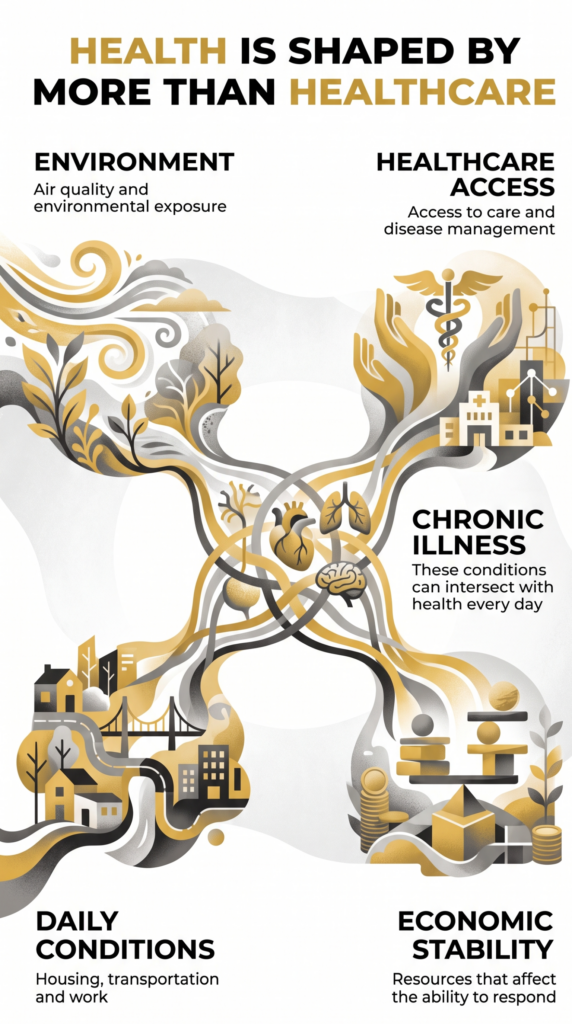
For someone managing asthma, autoimmune disease, cancer, cardiovascular disease, or multiple chronic conditions, environmental exposure is not only about future risk. It can intersect with symptoms, disease management, healthcare access, physical activity, economic stability, and quality of life right now.
On August 15, 2026, I joined NOWINCLUDED’s Clear the Air in Houston, representing The AIP BIPOC Network (ABN) on an environmental justice panel alongside Former Council Member Dr. Letitia Plummer and Rev. Crystal Bates, Vice Chair of the Environmental & Climate Justice Committee for the Texas State NAACP.

The program paired a screening of NOWINCLUDED’s Houston’s Fifth Ward Exposed with an Ask the Expert session on lung health featuring Dr. Susan Gaeta of MD Anderson Cancer Center, the environmental justice panel, and opportunities for attendees to connect with health and community resources, including MD Anderson Cancer Center, Harris Health, Respire Institute, and the African American Male Wellness Agency through UpliftHER, among others. Attendees were also invited to complete pre- and post-event surveys.
The conversation raised a larger question that extends well beyond one event or one community:
How do we pursue structural environmental change while also supporting the health of people who cannot wait for that change?
Key Takeaways
- Environmental justice should consider cumulative health burdens, not environmental exposure in isolation.
- People already living with chronic illness may have additional vulnerabilities when environmental, social, and healthcare barriers overlap.
- Research increasingly supports examining environmental exposures as one component of the complex factors that influence inflammatory and immune-mediated disease, without reducing autoimmune disease to a single environmental cause.
- Environmental justice requires both immediate support for affected communities and long-term action to address the systems creating environmental risk.
- Structural environmental change remains essential, but communities also need practical health information, healthcare access, resources, and advocacy while that work continues.
- Access, Inclusion, and Prevention provide a useful framework for examining environmental justice through a chronic illness lens.
The Fifth Ward Story Made the Stakes Visible
Houston’s Fifth Ward Exposed gave the environmental justice discussion a specific community context.
The documentary examines the experiences of residents of Houston’s Greater Fifth Ward alongside experts and public officials, connecting environmental contamination with longstanding health concerns in a community affected by a documented cancer cluster.
Historical operations at the Union Pacific Railroad wood-treatment site on Liberty Road resulted in soil and groundwater contamination in the Fifth Ward and Kashmere Gardens area. Public health investigations have subsequently examined cancer rates and environmental contaminants in the surrounding community.
Dr. Plummer’s presence in both the documentary and the panel created a natural connection between the community experiences presented on screen and the discussion that followed.
ABN was already familiar with the documentary through an earlier screening at ROCK the Block. At Clear the Air, the Fifth Ward story served as more than background. It grounded the conversation in the experiences of a community that has spent years navigating questions about environmental exposure, health, accountability, and response.
Environmental justice discussions can become highly technical, centered on exposure levels, monitoring, regulatory thresholds, remediation, risk, and epidemiology. Those tools are necessary, but they do not fully capture what it means to live with uncertainty about an exposure, question whether health problems may be connected, or wait for institutions to determine what happens next.
That gap between identifying environmental risk and living with its consequences is where the Fifth Ward story becomes especially relevant to chronic illness.
Fifth Ward is a Case Study, Not the Boundary of the Issue
Fifth Ward provided the context for the event, but environmental injustice is not a Fifth Ward problem or a Houston problem.
Across the United States, environmental burdens intersect with decades of decisions about housing, transportation, industrial development, land use, infrastructure, and economic investment.
That history matters because exposure rarely occurs in isolation.
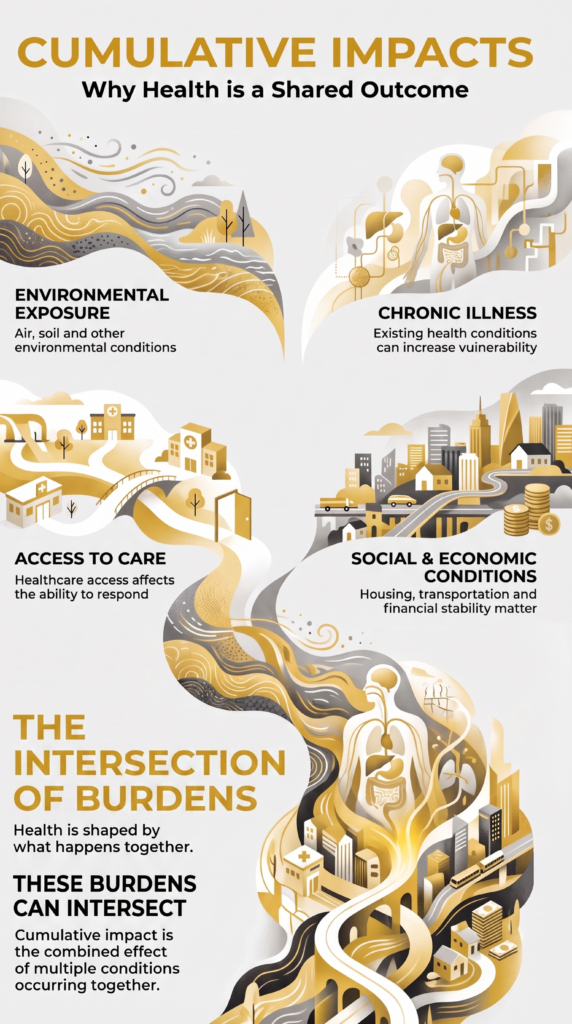
The U.S. Environmental Protection Agency describes cumulative impacts as the combined effects of chemical and nonchemical stressors on health, well-being, and quality of life.
That concept is particularly relevant when discussing historically under-resourced communities.
A person may be exposed to air pollution while also managing inadequate access to healthcare, transportation barriers, housing instability, occupational exposures, financial stress, limited green space, or an existing chronic condition.
Each factor matters independently.
Their intersection can matter even more.
That is why environmental justice cannot be reduced to asking whether a pollutant exceeds a particular threshold. We also have to examine the conditions surrounding the person who is being exposed.
What Changes When Someone is Already Living With Chronic Illness?
For people already managing chronic conditions, environmental health becomes part of disease management, not simply a discussion about disease risk.
The relationship is especially clear with respiratory health.
Fine particulate matter, including PM2.5, can penetrate deeply into the respiratory system. The U.S. Environmental Protection Agency has associated particle pollution with aggravated asthma, decreased lung function, respiratory symptoms, cardiovascular effects, and other adverse health outcomes.
For someone living with asthma, that can turn air quality into a disease-management issue.
The relationship with autoimmune disease requires more caution.
Autoimmune diseases result from complex interactions among genetics, immune function, environmental influences, hormonal factors, and other mechanisms. Current research is examining how exposures including particulate matter and other pollutants may contribute to oxidative stress, systemic inflammation, and immune dysregulation.
Associations have been investigated across conditions including rheumatoid arthritis, lupus, Sjögren’s syndrome, and systemic sclerosis.
That evidence does not support saying that air pollution simply causes autoimmune disease.
It does support asking better questions about how environmental conditions may interact with immune-mediated disease and why people living with autoimmune conditions should be included in environmental health research and policy conversations.
For me, that distinction matters.
I understand chronic illness not only through advocacy, but through lived experience. Environmental health discussions look different when the question is not simply whether exposure might make someone sick someday, but what it means when someone is already managing their health every day.
Environmental Injustice is Also a Quality-of-Life Issue
Disease incidence and mortality are essential measures of environmental health, but they are not the only measures that matter.
Chronic illness already requires people to make constant calculations about symptoms, medications, appointments, physical activity, work, family responsibilities, and finances. Environmental conditions can add another layer.
- Can I safely exercise outside today?
- Does my work environment increase my exposure?
- Can I afford tools, such as air filtration, that could reduce my exposure?
- If I learn that my community has experienced a particular environmental hazard, can I access appropriate healthcare or screening?
These questions point to a larger inequity:
The ability to avoid or respond to environmental risk is itself unequally distributed.
Two people may receive the same air-quality warning and have very different abilities to act on it.
One may work remotely, own an air purifier, have comprehensive health insurance, and easily reschedule outdoor activity.
Another may work outside, depend on public transportation, live in poorly maintained housing, or have limited access to healthcare.
Exposure matters.
So does the capacity to respond to exposure.
Supporting Health in the Midst of Structural Change
One of the questions directed to me during the panel addressed a challenge at the center of environmental justice:
How can community networks support individuals who are currently suffering from chronic illness or environmental exposure while the larger structural fight for justice takes place?
Environmental justice requires structural solutions. Communities cannot education-program their way out of industrial pollution. Individuals cannot lifestyle-change their way out of contaminated soil. An AQI app cannot replace environmental regulation, enforcement, remediation, or sound public policy.
But structural change takes time, and people still need support while it is happening.
That creates an important role for community organizations, healthcare systems, advocates, researchers, and public health institutions.
We can help people understand credible environmental health information. We can connect residents with healthcare, screening, benefits, and community resources. We can help people recognize questions worth bringing to their healthcare providers. We can also create mechanisms for communities to document and communicate what they are experiencing.
Just as importantly, that information needs to travel in the other direction.
Community knowledge should inform research questions, program design, public health interventions, advocacy priorities, and policy. People experiencing environmental burdens should not simply receive information after decisions have already been made. Their experiences should help shape the decisions themselves.
The goal is not to substitute community support for structural change.
The goal is to make sure people are not abandoned while structural change is being pursued.
Access, Inclusion, and Prevention in Practice
The conversation also reinforced how ABN’s AIP framework, Access, Inclusion, and Prevention, applies to environmental justice.
Not as three definitions, but as three questions:
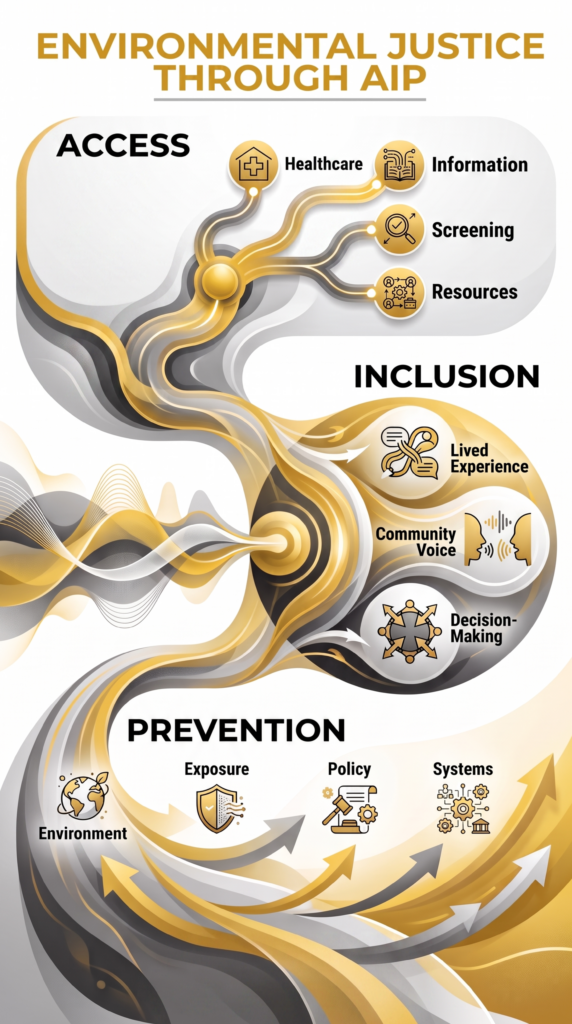
Access: What Can People Actually Reach?
It is not enough for environmental data, healthcare services, screening programs, or community resources to exist.
Can the people who need them find them, understand them, afford them, trust them, and use them?
Environmental justice requires us to consider access not only to a healthy environment, but also to the resources people need when that environment has already affected their health.
Inclusion: Who Helps Define the Problem?
Communities affected by environmental hazards should not enter the process only after researchers, institutions, or policymakers have already decided what questions matter.
Residents hold knowledge that cannot be captured entirely through environmental monitoring or medical records.
Meaningful inclusion means involving communities in defining problems, identifying priorities, shaping research, evaluating interventions, and determining what successful change looks like.
Prevention: How Far Upstream Are We Willing to Go?
Prevention is often framed around individual behavior.
For chronic illness communities, we hear a great deal about nutrition, exercise, medication adherence, stress, sleep, and preventive care.
Those things matter.
But prevention also requires looking upstream:
- What conditions are producing risk before someone enters a clinic?
- What exposures could be reduced?
- What policies determine where environmental hazards are concentrated?
- What happens when the healthier choice is not realistically available?
Environmental justice expands prevention from what individuals should do to what systems should stop doing to them.
Responsibility Cannot Stop With the Individual
There are practical things individuals can do.
People can monitor the Air Quality Index, learn about environmental concerns where they live, pay attention to patterns between environmental conditions and symptoms, discuss those concerns with healthcare providers, participate in public meetings, and support community advocacy.
Those actions have value.
But an environmental justice framework should resist turning systemic problems into another list of responsibilities for people already carrying the burden.
Healthcare organizations can ask more consistently about environmental conditions affecting patients.
Researchers can involve communities earlier and more meaningfully.
Community organizations can connect education with navigation and resources.
Industry has responsibilities related to environmental stewardship, transparency, and the communities affected by its operations.
Policymakers and regulators have responsibilities for standards, monitoring, enforcement, remediation, investment, and accountability.
And advocates can continue pushing environmental health into broader conversations about chronic disease and health equity.
Everyone has a role, but those roles are not equal.
The person breathing polluted air should not carry the same responsibility for solving the problem as the institutions with the power to prevent or reduce the exposure.
Where the Chronic Illness Community Fits
Clear the Air reinforced for me that environmental justice is not outside the scope of chronic illness advocacy. If our work addresses quality of life, prevention, healthcare access, disparities, and the conditions that influence health, environmental health is already part of that work.
We do not need to become environmental scientists to participate responsibly. We do need to understand the evidence, avoid overstating what the science can prove, partner with people who hold expertise we do not, and ensure that people living with chronic illness are represented in conversations that affect their health.
Environmental justice adds another dimension to how we think about Access, Inclusion, and Prevention, while chronic illness adds another dimension to how environmental justice is understood.
Moving the Conversation Forward
At the end of our panel, we were asked what immediate action people could take to support environmental justice and advocate for lung health.
My answer was about knowing what is happening in our own environments and using that knowledge beyond ourselves.
After reflecting on the entire conversation, I would take that one step further.
We need to stop treating environmental exposure, chronic illness, healthcare access, social conditions, and community voice as separate conversations.
For many communities, they are happening at the same time.
Our response should reflect that reality.
Protecting health means addressing not only how people manage illness, but also the conditions in which they are being asked to manage it.
Frequently Asked Questions
What does environmental justice have to do with chronic illness?
Environmental conditions can intersect with disease management, healthcare access, work, housing, transportation, and quality of life. For people already living with chronic illness, environmental justice is not only about future health risks. It is also about the conditions affecting health now.
What are cumulative impacts in environmental health?
Cumulative impacts are the combined effects of multiple environmental and non-environmental stressors. Environmental exposure may occur alongside chronic illness, limited healthcare access, housing challenges, transportation barriers, occupational exposures, or financial stress. Looking at these conditions together provides a more complete picture of health risk.
Why can the same environmental exposure affect people differently?
People do not have equal resources or opportunities to respond to environmental risks. Healthcare access, housing, occupation, transportation, income, existing health conditions, and other factors can affect someone’s ability to reduce exposure or manage its effects.
What is the connection between environmental exposures and autoimmune disease?
Research is examining associations between environmental exposures and autoimmune diseases, including possible roles for inflammation, oxidative stress, and immune dysregulation. Autoimmune diseases are complex and influenced by many factors, so an association does not mean a particular exposure directly caused someone’s disease.
Why should people with chronic illness be included in environmental justice research and policy?
People living with chronic illness can provide insight into how environmental conditions affect symptoms, healthcare, work, mobility, finances, and daily life. Their experiences can help inform research, public health programs, advocacy, and policy decisions.
How can communities support people while larger environmental problems are being addressed?
Communities can connect people with credible information, healthcare, screening, resources, and opportunities to participate in decisions affecting their health. Those efforts should complement, not replace, structural solutions such as regulation, enforcement, remediation, and policy change.
Sources & Further Reading
- Houston Health Department: Fifth Ward/Kashmere Gardens Union Pacific Railroad Site Contamination and Area Cancer Cluster
Official information on the former railroad wood-treatment site, soil and groundwater contamination, environmental testing, and cancer investigations in the surrounding Fifth Ward and Kashmere Gardens communities.
Houston Health Department: Fifth Ward/Kashmere Gardens Site Contamination and Cancer Cluster - Texas Department of State Health Services: Assessment of the Occurrence of Cancer, Houston, Texas
State cancer surveillance analysis examining cancer occurrence in census tracts surrounding the former railroad creosote-treatment facility near Greater Fifth Ward and Kashmere Gardens.
Texas DSHS: Assessment of the Occurrence of Cancer - U.S. Environmental Protection Agency: Cumulative Impacts Explained
EPA defines cumulative impacts as the combined effects of chemical and nonchemical stressors on health, well-being, and quality of life, including stressors experienced across the built, natural, and social environments.
EPA: Cumulative Impacts Explained - U.S. Environmental Protection Agency: Health and Environmental Effects of Particulate Matter
EPA summarizes evidence linking particle pollution with aggravated asthma, decreased lung function, respiratory symptoms, cardiovascular effects, and other adverse health outcomes.
EPA: Health and Environmental Effects of Particulate Matter - Journal of Translational Autoimmunity: Airborne Culprits: A Comprehensive Review of PM, Silica, and TCDD in Autoimmune Diseases
This peer-reviewed review examines research on environmental pollutants, oxidative stress, inflammation, immune dysregulation, and autoimmune diseases including rheumatoid arthritis, systemic lupus erythematosus, Sjögren’s syndrome, and systemic sclerosis.
PubMed: Airborne Culprits and Autoimmune Diseases
About the AIP BIPOC Network
The AIP BIPOC Network is a nonprofit community health organization working to improve quality of life for people impacted by autoimmune disease and chronic illness, with an emphasis on communities that have historically experienced barriers to healthcare, information, and resources.
Through our dual AIP framework, Autoimmune Protocol + Access, Inclusion, Prevention, and our five pillars of Awareness, Advocacy, Action, Assessment, and Alignment, ABN connects health education, community engagement, wellness, resource access, advocacy, and partnerships to address individual needs and the broader conditions that influence health.
Related Posts



Jamie Nicole is the founder and CEO of The AIP BIPOC Network and The Natural HEALing Coach, LLC. She is a patient advocate, speaker, certified health coach, fitness instructor, and guest host of the Arthritis Foundation’s Live Yes! With Arthritis podcast. She also serves as Board Secretary for Bee Busy Wellness Center, a Federally Qualified Health Center, and as a member of the Project Sleep Advisory Board.
Drawing from her professional experience and lived experience with Hashimoto’s thyroiditis, rheumatoid arthritis, osteoarthritis, narcolepsy, and asthma, Jamie works to improve quality of life for people navigating autoimmune disease and chronic illness. Her work centers community health education, wellness, advocacy, patient engagement, strategic partnerships, and the inclusion of lived experience in healthcare and research.
View CommentsLEAVE A COMMENT
View CommentsLEAVE A COMMENT
Leave a Reply


Programs Overview
Past Events
ROCK Weekend
Upcoming Events
Blog
Resource Hub
Sponsor
Volunteer
Partner with Us
Ways to Support
Share Your Story
Join Our Network
Our Impact
Why BIPOC?
Our Approach
Who We Are
Common Questions
Community Care Collaborative
ROCK it Wellness
The AIP BIPOC Community
The AIP BIPOC Roundtable
Powering Advocacy
© 2026 The AIP BIPOC Network, INc | EIN # 92-2526059 | all rights reserved | legal